





导言
It happens every single day around 4:00 PM in lash salons all over the world.
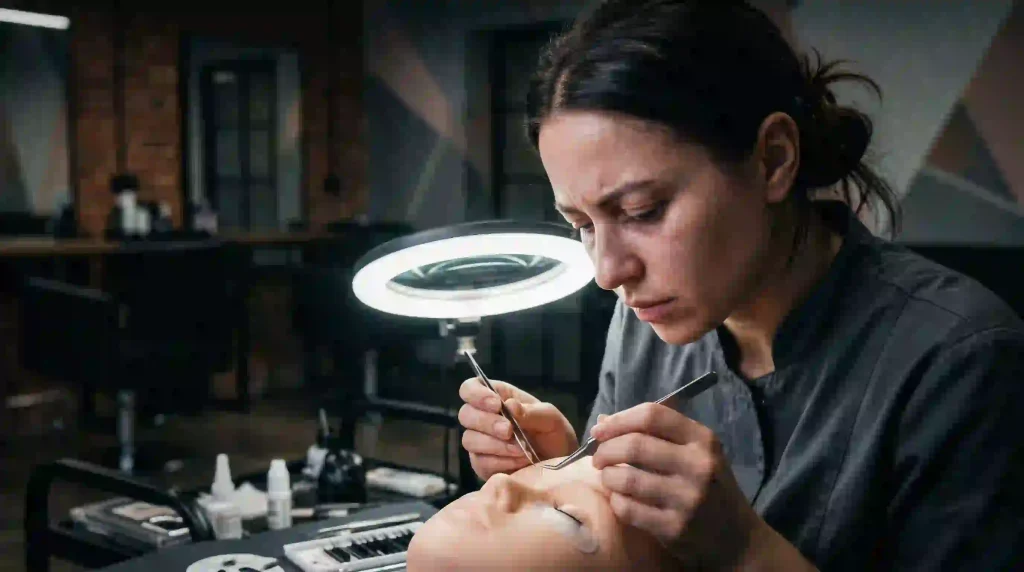
A lash artist starts to feel that familiar, dry burning sensation behind her eyes. Her vision gets just a little bit blurry when trying to isolate those stubborn, fine inner-corner lashes. A dull ache creeps up her neck and settles right into her shoulders.
I talk to salon owners and artists constantly, and most of them just accept this pain as a “normal” part of the job. They think their bodies are simply wearing out. Some even consider leaving the industry in their early thirties because they physically can’t handle a fully booked day anymore.
But as an optical engineer who has spent years designing professional lighting systems, I have to tell you the truth: your body isn’t the problem. The light you are working under is the problem.
Using a cheap, repurposed social media light to perform millimeter-level micro-precision work is an ergonomic disaster. If you want to protect your most valuable asset—your vision and your spine—it’s time to take a hard look at your workspace.
Here is the real science behind why a professional, CRI > 95 half-moon light is the ultimate career-saver for lash artists.
1. The Anatomy of Lash Artist Burnout
To fix the problem, we first have to respect how incredibly demanding lashing is on the human body. Unlike cutting hair or doing makeup, applying lash extensions is essentially microscopic work.
1.1The Micro-Precision Demand
You are isolating a single natural lash and applying a synthetic fiber that is often just 0.03mm thick. You are doing this holding sharp tweezers incredibly close to a client’s eye.
To pull this off, the tiny ciliary muscles inside your eyes are flexing constantly to maintain sharp focus. If your lighting is weak, shadowy, or washed out, your eyes have to work overtime just to process what you are looking at. This constant straining leads straight to severe visual fatigue, chronically dry eyes, and eventually, the loss of your near-focusing ability.
1.2The Posture-Vision Link
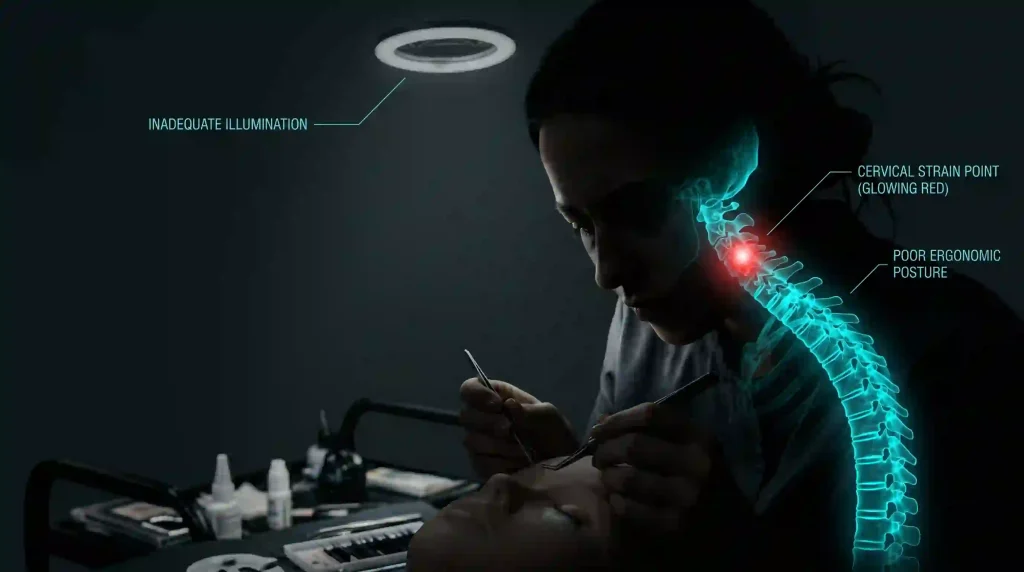
But it doesn’t stop at your eyes. Visual strain instantly attacks your posture.
The biomechanics are actually pretty simple. When your eyes can’t see a tiny detail clearly, your brain instinctively tells your body to physically move closer to the object. You start hunching your shoulders. You crane your neck forward, slowly ruining your natural cervical curve over a two-hour appointment.
Bad lighting isn’t just an eye issue. It is the direct root cause of the chronic neck and back pain that forces amazing artists out of this industry.

2. Decoding CRI: Seeing the Invisible
So, how do we fix this? It’s not about just making your room brighter. Buying a brighter cheap light only creates harsh glare that makes you squint more. The real secret to optical clarity is something called the Color Rendering Index, or CRI.
2.1What is CRI?
CRI is a scientific metric from 0 to 100 that measures how accurately a light shows the true colors of an object, compared to natural sunlight. If a light has a CRI of 100, you are basically looking at things under perfect daylight.
Most cheap desk lamps, standard ring lights, and hardware store LEDs hover around an 80 CRI. And that is where the problem begins.
2.2Why 80 CRI is Failing You
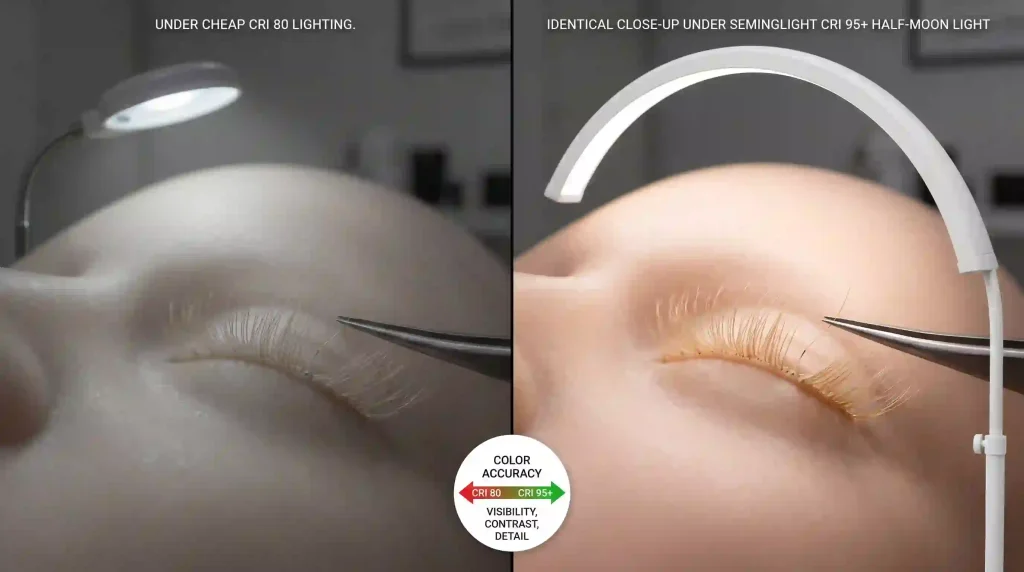
Working under an 80 CRI light makes everything look flat and muddy. Fine, blonde natural lashes blend right into the client’s skin. A tiny bit of leftover dried adhesive from a previous set becomes almost invisible.
On top of that, your client’s skin takes on this dull, greyish tint that completely ruins your before-and-after photos. Because the light is artificially flattening the natural contrast of the lash line, your eyes have to strain just to separate the layers.

3. The R9 Factor and Medical-Grade Clarity
At Seminglight, we don’t use standard commercial LEDs. If you want medical-grade clarity, you have to look deeper into the light spectrum, specifically at something called the “R9” value.
3.1Why Red Rendering Matters
A light might claim to have a high overall CRI, but completely fail at rendering red tones. That is the R9 value. Why do lash artists care about red? Because human eyelids, skin, and the tiny capillaries along the lash line are packed with red and pink tones.
Our half-moon systems use custom-selected LED chips with a CRI of 95+ and a specifically high R9 value. This ensures the delicate eyelid margin looks vividly lifelike.
3.2Faster Isolation, Less Strain
When you work under a 95+ CRI light, the visual contrast is startling. The difference between a pale natural lash and a dark synthetic extension is razor-sharp. You can instantly spot microscopic dust or a bad adhesive bond.
Because the contrast is so pure, you don’t have to squint. Every time you isolate a lash without hesitation, you save a second. Multiply that across a heavy volume set, and you are saving immense time and energy every single day.
4. The Half-Moon Arc: Killing the “Shadow Trap”
Color accuracy is huge, but the actual physical shape of your light matters just as much. Let’s talk about why the beauty industry needs to move on from the ring light.
4.1The Ring Light Was Made for TikTok
Ring lights are fantastic inventions—if you are a social media influencer recording a makeup tutorial. They were designed to light up a vertical human face and put a nice little catchlight in your eyes.
But you aren’t lighting a vertical face. You are lighting a flat canvas (a client lying on a bed). When you point a ring light straight down, the light is coming from one concentrated circle above you.
4.2The Shadow Trap
The moment you bring your hands, tweezers, and glue ring into that space, you block the light. You cast deep, crisscrossing shadows right over the client’s natural lashes. To see past your own shadows, you tilt your head or bend your spine. Doing this for eight hours a day will destroy your neck.
4.3The Medical Geometry of the Arc
To solve this, we looked at hospital operating rooms. Surgeons don’t use single-point lights; they use massive, multi-directional arrays.
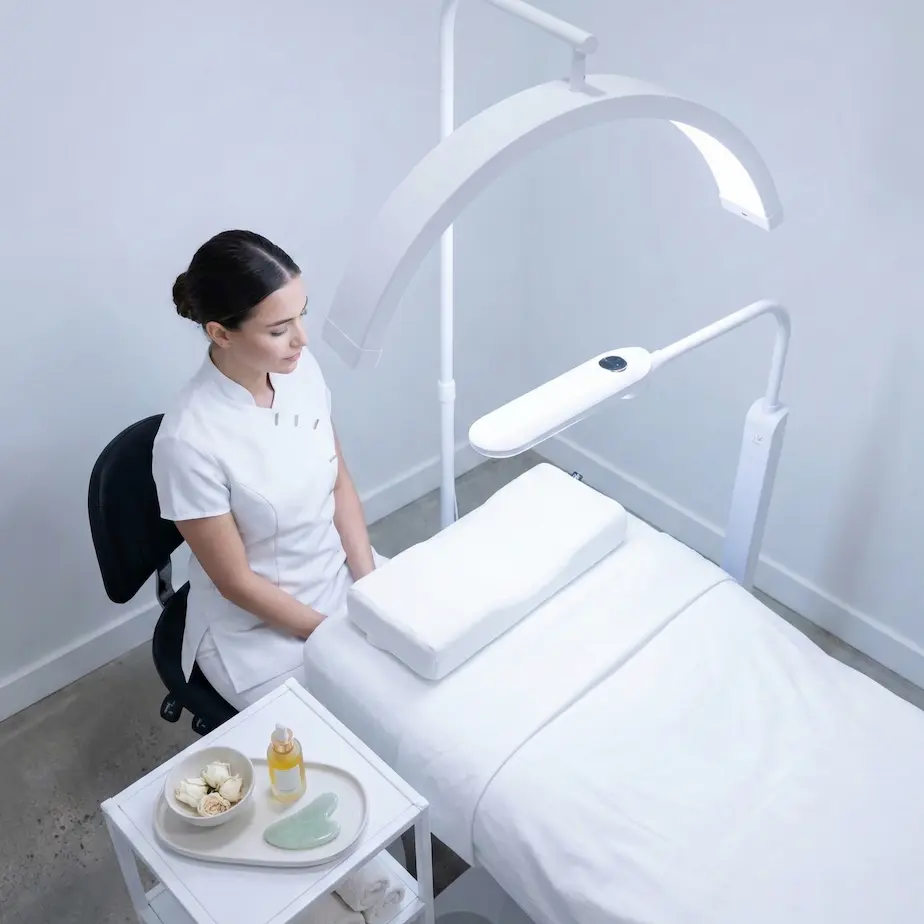
A commercial half-moon light applies this exact geometry. The 180-degree curved LED array wraps entirely around the client’s head. When your left hand holds the isolation tweezer, the light from the right side of the arc fills in the shadow. It acts like a surgical shadowless lamp. You can finally sit up straight and let the light do the heavy lifting.

5. Flicker-Free Engineering: The Migraine Cure
There is an invisible threat in cheap lighting that nobody talks about: low-frequency flicker.
5.1The PWM Dimming Trick
To keep manufacturing costs low, cheap lighting brands use basic PWM (Pulse-Width Modulation) drivers to dim their lights. When you turn the brightness down, the light isn’t actually getting softer. It is just turning completely on and completely off thousands of times a second.
5.2A Strobe Light for Your Optic Nerve
You can’t consciously see it blinking, but your optic nerve and brain process every single micro-flash. Your pupils are constantly trying to adjust. This leads directly to debilitating migraines and intense visual fatigue. You are essentially trying to do precision micro-surgery in a strobe-lit nightclub.
5.3The Constant-Current Difference
We refuse to play that game. Seminglight units are built with expensive, laboratory-grade constant-current motherboards. This means our LED chips receive a perfectly smooth, uninterrupted flow of electricity no matter how low you dim the light. A zero-flicker light isn’t a luxury feature; it is a medical necessity for anyone working long hours.
6. Adapting to Your Biological Clock
Your body’s lighting needs change throughout the day. Staring at the exact same light temperature from 9 AM to 7 PM is exhausting.
6.1Color Temperature (Kelvins)
During the morning rush, a cool white light (around 5500K) is perfect. It maximizes visual contrast, stops you from feeling sleepy, and keeps your brain alert.
But staring at that intense, blue-tinted hospital light late into the afternoon is incredibly harsh on your retinas and messes with your sleep cycle.
A professional half-moon light lets you smoothly adjust the color temperature. When you shift the dial to a softer, warmer tone (around 4000K) in the early evening, you instantly relieve the tension in your eyes while keeping perfect visibility across the lash bed.
7. Keeping Your Canvas Cool
Let’s not forget about heat. High-intensity lighting generates heat, and how a manufacturer deals with that heat affects both you and your adhesive.
Cheap LED lights usually use plastic housings. Plastic traps heat, forcing it to radiate downward onto the client’s forehead. A sweaty, uncomfortable client makes your job harder, and that ambient heat can actually mess with the curing time of your lash glue.
Our commercial half-moon lights are built with aerospace-grade aluminum. Aluminum breathes. It pulls the heat away from the LEDs and dissipates it upward into the room, meaning the light hitting your client’s face is 100% cold.
8. The Real Return on Investment
A lot of salon owners look at premium lighting and see an expensive luxury. I challenge you to look at it as an investment in your human capital.
If your top lash artist has to call out sick or cancel two appointments because of a severe migraine or a stiff neck, how much revenue did the salon just lose? The cost of employee burnout, physical therapy, and staff turnover is devastating to a business.
A shadowless, high-CRI half-moon light protects your artists’ health. It speeds up their application time because they aren’t fighting shadows. And it instantly elevates the look and feel of your salon. The ROI usually pays for itself within the first week.

Conclusion: Phase One of the Perfect Lash Station
Upgrading your lighting is the single best decision you can make for your physical longevity in this industry. Eliminating shadows, demanding true color accuracy, and killing the flicker is Phase One of building a professional workspace.
But “seeing clearly” is only half the battle.
Once your isolation is perfect under the half-moon light, you need a way to instantly lock that adhesive bond in place without worrying about room humidity or sticky stickies.
If you want to know how to combine this shadowless illumination with 0.5-second instant UV curing technology, you can comntact with us.
Protect your eyes. Protect your spine. Never compromise on your tools.