









1. Why Glasses Glare Ruins Your Stream
The ring light is positioned perfectly. The brightness is dialed in just right. The camera is framed and ready to go.
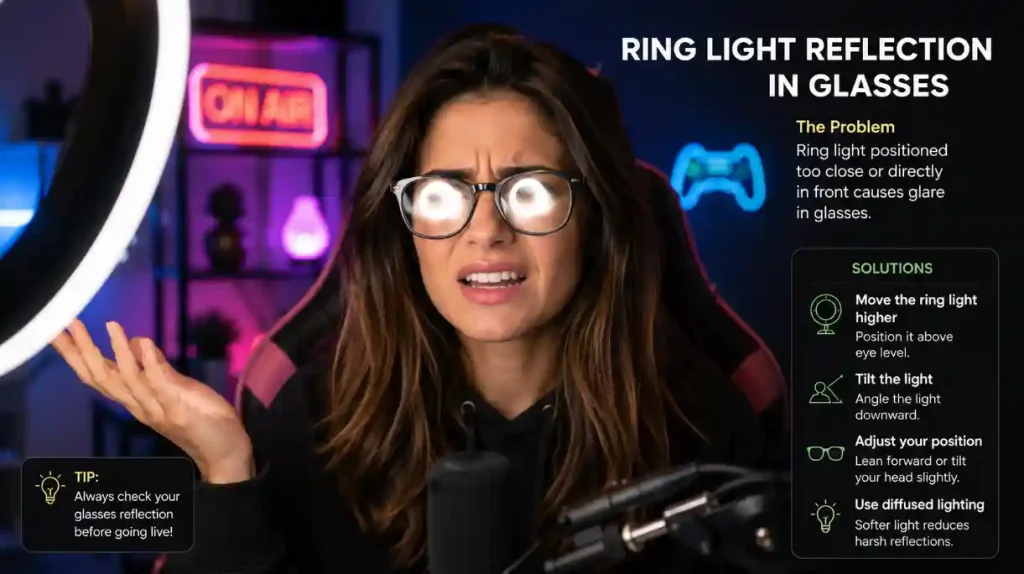
Suddenly, your stream is ruined. Bright circular reflections obscure your eyes. Viewers see the ring light reflected in your lenses instead of your actual expression. Your professional setup now looks amateur.
Ring light glare on glasses is one of the most frustrating problems for anyone who wears prescription glasses and uses a ring light. It affects Twitch streamers, YouTubers, makeup artists, and even professionals on Zoom calls.
The root cause is physics. Light from the ring light hits the curved surface of your lenses and reflects directly back into the camera lens. Because the ring light surrounds the camera, the reflection appears as a perfect circle right over your eyes.
The good news? This problem is solvable. This article covers five proven methods to eliminate ring light glare, from simple angle adjustments to professional-grade solutions.
According to lighting for glasses wearers, understanding light reflection angles is the first step to solving this common problem.
A ring light for streaming can work perfectly with glasses—you just need the right setup.
2. Understanding the Glare Problem
2.1 The Science Behind Glare
Glare happens when light reflects off a surface at the same angle it hits. With a ring light, the LEDs are arranged in a circle around your camera lens. Your glasses sit directly in the path of this light. The curved surface of your lenses acts like a mirror, reflecting the circular light pattern directly into the camera.
Two factors determine how much glare you experience:
| Factor | How It Affects Glare |
|---|---|
| Lens coating | Anti-reflective (AR) coating reduces reflections significantly |
| Lens curvature | More curved lenses (stronger prescriptions) create more surface area for reflection |
| Light intensity | Brighter light = more visible glare |
| Angle of incidence | The more directly light hits your lenses, the stronger the reflection |
2.2 Why Ring Lights Make Glare Worse
Ring lights are worse for glasses glare than other lighting types because of their unique design. Unlike a softbox that sits off to the side or an overhead panel, a ring light wraps around the camera lens. This means the light travels from the same direction as the camera, reflecting directly off the lenses and straight into the lens.
The reflection appears as a bright ring or crescent right over your eyes. This obscures your expression and looks unprofessional to your audience.
The glare reduction techniques for video confirm that understanding light direction is the foundation of glare management.
3. The 5 Proven Solutions
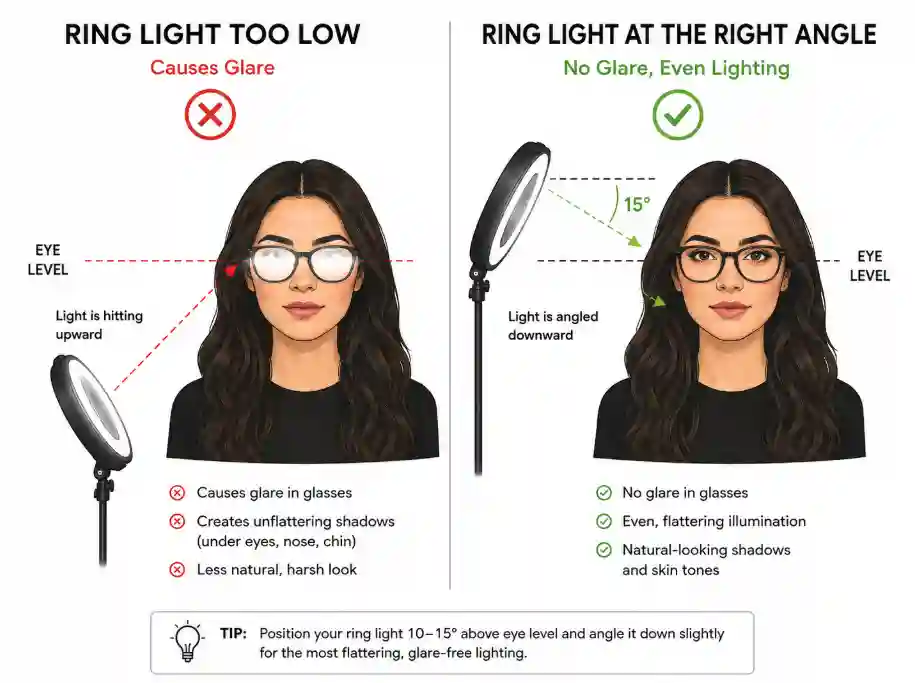
3.1 Solution 1: Raise the Ring Light (Angle Adjustment)
The simplest fix: change the angle of the light.
How it works: When you raise the ring light so it sits 10 to 15 degrees above eye level, the light reflects downward instead of directly into the camera lens. The glare shifts to the bottom edge of your glasses or disappears entirely.
Step-by-step:
Adjust your ring light stand to position the light 6 to 12 inches higher than eye level
Tilt the light downward slightly so it still illuminates your face
Check your camera preview to confirm the glare has moved or disappeared
Pros: Free, easy, requires no new equipment
Cons: May change the quality of light on your face; shadows under eyes may appear
3.2 Solution 2: Tilt Your Glasses
A slight adjustment to how your glasses sit on your face can make a significant difference.
How it works: Changing the angle of your lenses changes the angle of reflection. When light hits the lenses at a different angle, it reflects away from the camera instead of into it.
Step-by-step:
Tilt the arms of your glasses slightly higher on your ears, lowering the front
Alternatively, rest your glasses slightly lower on your nose
Check the camera preview for glare reduction
Adjust until reflections disappear
Pros: Free, immediate, no equipment needed
Cons: May feel slightly uncomfortable; glasses may slide if not properly adjusted
3.3 Solution 3: Use a Diffusion Filter
Adding a diffusion filter, also known as a “glare diffuser,” softens the light and reduces reflection intensity.
How it works: A diffusion filter spreads light rays in multiple directions rather than sending them directly toward your lenses. This reduces the “mirror-like” reflection that creates sharp glare.
Options include:
White diffusion fabric that clips over the ring light
Frosted diffusion gels
Translucent makeup powder (professional photographers often use this trick—applying a thin layer of translucent powder to your glasses to reduce reflection, though it slightly reduces clarity)
Step-by-step:
Clip or attach a diffusion filter over your ring light
Turn brightness up slightly to compensate for light loss
Check camera preview for glare reduction
Pros: Effective, also softens harsh light overall
Cons: Reduces brightness slightly; costs $15-30
3.4 Solution 4: Change Your Position or Distance
Sometimes, the fix is as simple as changing where you sit.
How it works: Moving closer to or farther from the ring light changes the size of the light source relative to your face. A smaller light source (farther away) reduces glare intensity.
Step-by-step:
If you sit 18 inches from the light, try 24-30 inches
Increase brightness to compensate for greater distance
Alternatively, move slightly off-center
Check preview and adjust
Pros: Free, easy to try
Cons: May not work if space is limited
3.5 Solution 5: Upgrade to Anti-Reflective Lenses
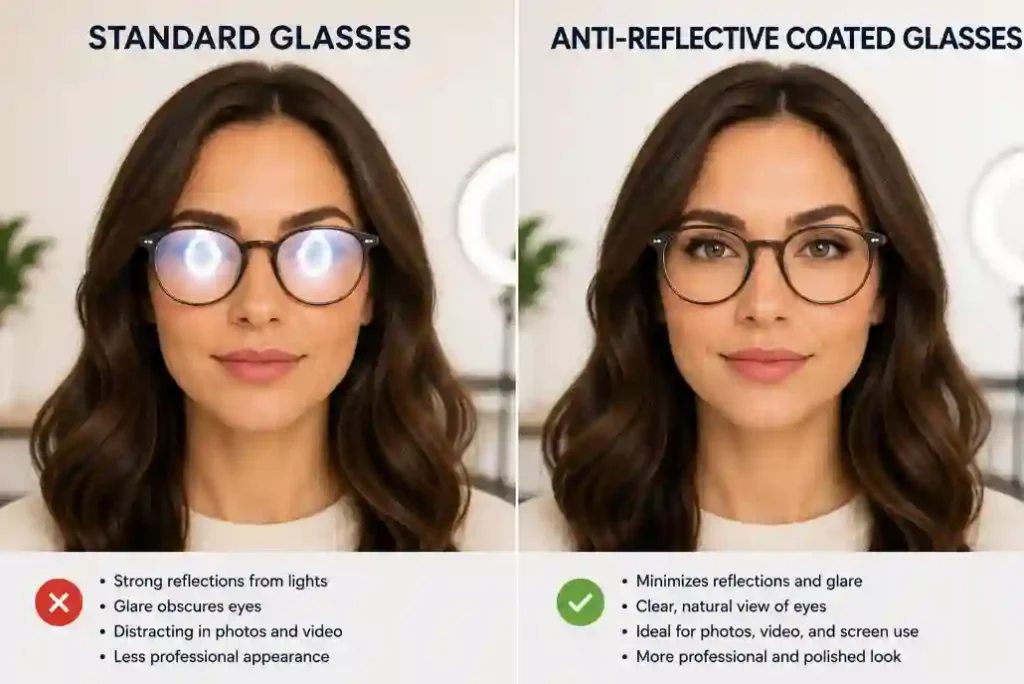
If you frequently face this problem, consider anti-reflective (AR) coatings on your glasses.
How it works: AR coatings reduce the amount of light reflected from your lenses from 8% (standard plastic) to less than 1%. This is the most effective long-term solution.
Step-by-step:
Visit your optician and ask about AR coating options
Specify that you need glasses for screen work and video production
Most opticians offer AR coating as an upgrade
Pros: Most effective; also reduces eye strain
Cons: Costs money (typically $50-100); requires new lenses or glasses
| Solution | Cost | Effort | Effectiveness |
|---|---|---|---|
| Raise the light | Free | Minimal | Moderate |
| Tilt glasses | Free | Minimal | Moderate |
| Diffusion filter | $15-30 | Low | High |
| Change distance/position | Free | Low | Moderate |
| Anti-reflective lenses | $50-100+ | High | Highest |
A dimmable ring light for streaming with adjustable brightness gives you more control when reducing or increasing light output to compensate for filters or distance changes.
Anti-reflective lenses are the most effective permanent solution for ring light glare. However, if brightness is causing you headaches, you may want to address that separately. For creators who also struggle with eye fatigue, check out our guide on fixing ring light headaches.
4. Quick Fix Comparison Table
For stubborn glare, combine solutions: quick setup (raise light + tilt glasses) works for 85% of users. If your ring light still feels insufficient, a dim ring light is also a common problem that may require different solutions entirely.
| Solution | Best For | Time to Implement | Success Rate |
|---|---|---|---|
| Raise the ring light | All users | 30 seconds | 70-80% |
| Tilt glasses | All users | 10 seconds | 60-70% |
| Diffusion filter | Regular streamers | 2 minutes | 80-90% |
| Change distance/position | Limited space setups | 1 minute | 50-60% |
| Anti-reflective lenses | Long-term solution | Days to weeks | 95%+ |
Solution Combination for Best Results
For stubborn glare, combine solutions:
Quick setup: Raise the light + tilt glasses (works for 85% of users)
Premium setup: Diffusion filter + raise the light (works for 95%)
Permanent fix: Anti-reflective lenses + raise the light (works for 99%)
5. When to Upgrade Your Ring Light
If you have tried all these solutions and still experience glare, consider upgrading to a ring light with different light dispersion characteristics.
Look for these features:
Dual-sided or bi-color LEDs allow you to change color temperature without changing brightness, reducing harshness
Higher CRI (95+) provides true color without needing intense brightness
Flicker-free certification reduces eye strain even with bright settings
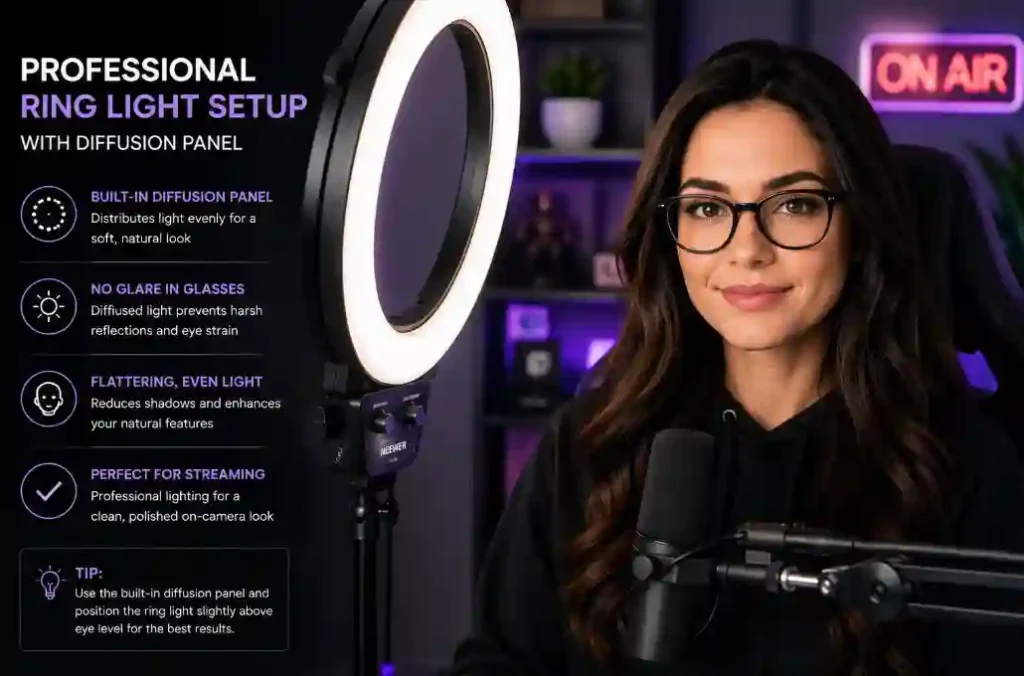
Some newer ring light models feature built-in diffusion panels or secondary lighting modes that reduce glare naturally. When shopping for a new ring light, test it with your glasses before purchasing.
The flicker-free ring light options can help you identify models that are safer for long streaming sessions and gentler on reflective surfaces.
A professional ring light for streaming with adjustable brightness and built-in diffusion options can significantly reduce glare issues from the start.
6. Final Verdict
| Key Takeaway | Action |
|---|---|
| Raise the ring light | Adjust stand to 10-15° above eye level |
| Tilt your glasses | Slight angle change reduces reflection |
| Use a diffusion filter | Clips on your ring light for $15-30 |
| Change distance | Move farther back (24-30 inches) |
| Upgrade AR lenses | The permanent fix for glasses wearers |
A ring light glare on glasses is frustrating, but it is not unsolvable. Start with the simplest fixes first—raising the light and tilting your glasses—and work your way up to filters and new lenses only if needed.
Most users will find that a combination of angle adjustment and distance changes solves the problem without spending any money. If you stream frequently and want professional results, investing in anti-reflective lenses is well worth the cost.
A note from Seminglight – We manufacture professional ring lights for streaming with CRI 95+ LEDs, flicker-free drivers, and adjustable brightness. Perfect for Twitch streamers, YouTubers, and professionals who wear glasses. Contact us for volume pricing or custom solutions.