





1. Why UV Lash Systems Are Surrounded by Confusion
UV lash systems are one of the hottest topics in the lash industry—and unfortunately, one of the most misunderstood . Walk into any lash forum or scroll through social media, and you will find passionate advocates alongside equally passionate skeptics.
The confusion is understandable. UV lash technology introduces a new variable—light—into a process that has relied on chemistry alone for decades. Questions about eye safety, long-term health effects, and allergy prevention have created a cloud of misinformation that can be difficult to navigate.
This comprehensive FAQ guide cuts through the noise. Drawing on evidence from industry educators, safety regulators, and lash technicians with real-world experience, we answer the most common questions about UV lash systems. Whether you are a salon owner considering the switch, a lash artist already using UV technology, or a client weighing your options, this guide provides clear, honest answers.
プロ仕様のUVまつげ用ライトをチェック backed by safety certifications
For step-by-step application training, see our salon SOP guide.

2. Safety Questions
2.1 Is UV lash technology safe?
Answer: Yes, when used correctly .
Safety comes down to control of light exposure and proper technique. UV/LED systems use focused light to cure the adhesive instantly. The risk comes from light entering the eye, not from the curing itself .
How light exposure is controlled:
Correct angle of light:
The lamp must be positioned to target the lash base only
Very short exposure:
Typically 1–2 seconds per cure
Proper eye coverage:
Silicone pads and UV-blocking protection for both client and artist
When done properly, exposure is minimal and controlled. As Locks Lash explains: “UV lash systems are safe in trained hands. They give you more control over curing, but they also require more control over your setup. If the light is managed properly, risk stays low” .
The American Lash Association has also recognized the shift. In early 2026, the ALA hosted a webinar titled “Understanding UV Light-Cured Systems: The Next Evolution in Professional Lashing,” featuring educator Jazmin Riordan . The session broke down the limitations of traditional adhesive systems, the science behind controlled curing, and how UV technology can enhance consistency, safety, and the overall client experience .
2.2 Does UV light damage the eyes?
Answer: Not when proper safety protocols are followed.
The key factor is dosage. During a full set of 100 lashes, the UV lamp is typically activated for 1–2 seconds per lash, resulting in a total exposure time of approximately 3 minutes per eye for the entire service . The client’s eyes remain closed throughout the application, and the eyelid blocks at least 95% of UV radiation from reaching the eye.
However, lash techs work with these lights all day. Without proper certification and shielding, you cannot be sure if long-term exposure is safe—even if the light looks “gentle” . This is why IEC 62471 certification matters. As an industry expert notes, “IEC 62471 is the international standard for photobiological safety. It ensures the light you are using is tested for risk to eyes and skin over prolonged exposure” .
Practical safety measures:
Both client and artist must wear UV-blocking glasses throughout the entire application
Use silicone protective pads on the client’s upper eyelid
Never look directly into the active UV light
Use lamps with shielding or angled beams to prevent direct eye exposure
Limit exposure times—do not hover the light longer than needed
2.3 Is a “white light” UV lamp safer than a purple 395nm lamp?
Answer: No—and this is one of the most misunderstood aspects of lash lighting.
White UV LED lamps often use phosphor coatings to convert the violet-purple glow into a softer, “white-like” appearance. But if they are curing UV glue, they still emit UVA radiation. The color is simply disguised—it is not safer unless the unit is built with proper shielding and certifications .
So no, white UV does not mean less UV. It means masked UV .
The industry standard remains the 395nm wavelength because it matches the photoinitiator activation range of UV lash adhesives (typically 365–405nm) . The 395nm wavelength hits the sweet spot—it is powerful enough to ensure a deep, consistent cure, especially for modern lash glues. Some brands use a 405nm UV lamp, but unless it closely matches the photoinitiator’s activation range, you risk under-curing—leading to poor retention or potential reactions .
UV lash lights with 395nm precision and IEC 62471 certification ensure safety and performance.
2.4 What about the technician’s cumulative UV exposure?
Answer: This is a valid concern that deserves attention.
Lash technicians work with UV lamps for hours every day, eight clients a day, five days a week. Unlike the client, who receives UV exposure only during their occasional appointments, the technician is exposed continuously. Even with the lamp pointed away, some UV scatter in the workspace is inevitable.
This is why, according to the Finnish Radiation and Nuclear Safety Authority (STUK), protective glasses should always be worn by both the client and the technician, not just the client, when the lamp is switched on at close range. The accumulated doses for the technician can be many times higher over a year than for any individual client.
If you are a technician who performs UV lash services daily, you should consider the following:
Always wear UV-blocking glasses—not just during curing, but throughout the entire service
Use shields or barriers to block scattered UV
Track your exposure time—consider rotating between UV and non-UV services to reduce cumulative dose
Ask your supplier for IEC 62471 test reports—this standard evaluates both client and operator safety
3. Retention and Performance Questions
3.1 Is retention better than traditional glue?
Answer: Strong evidence in practice says yes—but conditionally .
Why UV often outperforms traditional adhesives:
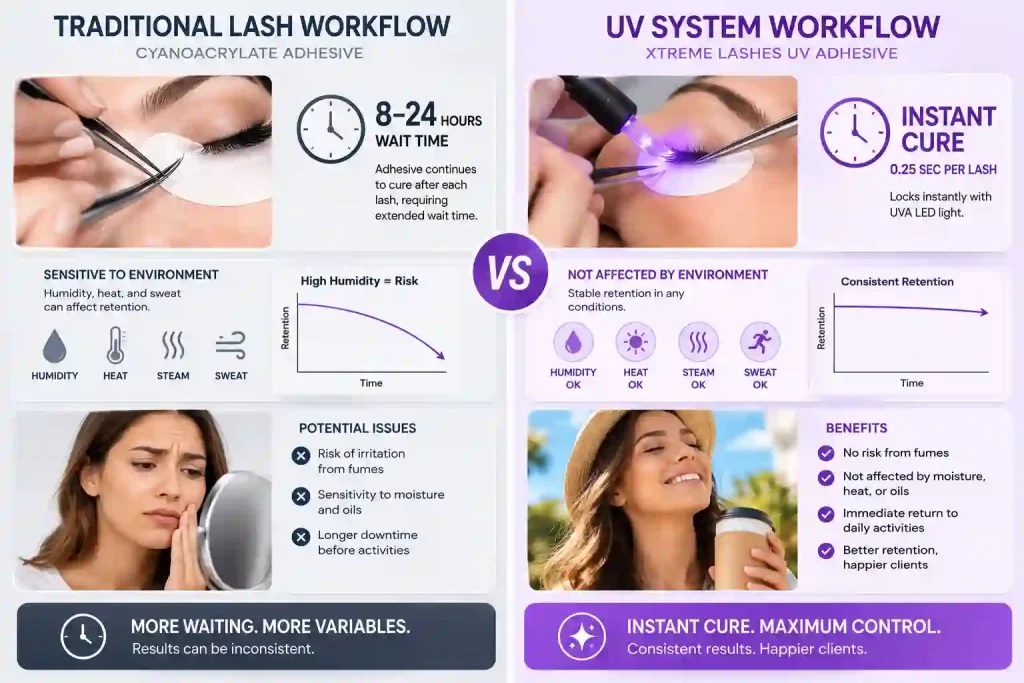
No under-curing due to low humidity: Traditional glue struggles when the salon is too dry
No shock polymerisation from high humidity: Traditional glue can “shock cure” in humid conditions, becoming brittle and failing early
More consistent bond formation: UV curing is controlled by light, not environmental conditions
However, application technique still matters. Poor isolation or placement will still fail regardless of curing method. As Noble Lashes explains, “UV-cured lashes can last up to 3 weeks, similar to traditional lashes. UV curing reduces application time and exposure to cyanoacrylate fumes” .
3.2 How much time does UV save?
According to CFB Cosmetics, the UV Lash System saves approximately 30% of the time compared to traditional application methods . Because the adhesive cures instantly upon UV exposure, there is no waiting period between placements and no post-service waiting period.
3.3 Can clients get their lashes wet immediately?
Yes. Traditional lash clients are told not to get their lashes wet for 24–48 hours. With UV-cured lashes, the adhesive is fully cured at the time of application. There is no grace period after the application—clients can shower, swim, and exercise immediately .
4. Allergy Questions
4.1 Can UV systems prevent lash glue allergies?
Answer: It significantly reduces risk but is not 100% guaranteed.
The key difference lies in the curing mechanism .
Traditional glue allergy trigger: Cyanoacrylate fumes. Traditional lash adhesive cures through moisture polymerization—a slow process that continues for 24–48 hours. During this entire window, the glue releases active cyanoacrylate monomers into the air. These heavy fumes settle onto the client’s lower lid and eyeball. Over time, the body’s immune system identifies these fumes as a threat and launches an attack—resulting in swollen, red, itchy eyelids .
UV system advantage: UV glue contains photo-initiators. When hit by 395nm UV light, these molecules trigger an instant polymerization. The glue transforms from liquid to solid in 0.5 to 1 second. Because the chemical reaction is 100% complete the moment the light turns off, the off-gassing stops immediately. By eliminating the 24-hour fume window, UV systems remove the primary trigger for the majority of allergy cases .
According to CFB Cosmetics, over 80% of particularly sensitive or allergic customers can use the UV Lash System . Locks Lash also notes that while it is not 100% guaranteed that people will not react, “there is a much higher chance they won’t” .
However, UV systems are not a cure-all. If a client has a true medical allergy to the acrylates family (the chemicals found in the glue itself), they may still react even if the glue is cured instantly .
4.2 Are UV adhesives completely fume-free?
Answer: No—they release fewer fumes, but the reduction is significant.
UV adhesives release fewer irritating vapors than cyanoacrylate glues. Clients who experience burning or watering often report quicker relief than with regular glue . However, those with strong allergies to cyanoacrylate may still react to UV glues, though often with milder symptoms .
The bottom line: UV is a massive risk reduction, not a cure. Think of it as bringing the allergen level below the threshold that triggers a reaction for most people .
4.3 Should I still do a patch test?
Absolutely. UV adhesives are not allergen-free. They contain photoinitiators and acrylate resins that can sensitize some individuals . Always perform a patch test if your client has a history of allergic reactions .
For more on allergy prevention techniques, see our allergy and safety protocol guide.
5. Product and Equipment Questions
5.1 What is the difference between UV glue and traditional lash extension glue?
| アスペクト | 伝統的な | UV/LED |
|---|---|---|
| キュアトリガー | Moisture (humidity dependent) | Light (environment largely irrelevant) |
| Result | Humidity-dependent cure time | Near-instant curing that the technician controls |
| Sensitivity to environment | High—requires 45-65% RH | None—UV curing works regardless of room conditions |
Traditional adhesive cures via anionic polymerization triggered by moisture. UV adhesive contains photo-initiators that remain dormant until exposed to UV light at 365nm or 405nm .
5.2 Do I need special training for UV lash systems?
Locks Lash HIGHLY recommends completing proper training before offering UV lashing services because technicians need to know the correct techniques and technology to ensure safety for both themselves and their clients . CFB Cosmetics notes that experienced stylists do not require additional training, but detailed instructions are provided with their UV system .
Noble Lashes emphasises: “Proper training is key before offering this service” .
5.3 Can I use UV light with my regular sensitive glue?
いいえ。. Traditional sensitive glue does not contain photo-initiators. Shining a UV light on it will do nothing. You must use a matched UV Glue + UV Light system .
5.4 How long does a UV lash lamp last?
With normal professional use (6–8 hours/day), a quality UV lash lamp should last 2–3 years. LED chips degrade over time. Replace when irradiance drops below 500 mW/cm² (test with a UV meter). Seming offers replacement lamp head modules for SM253 series to extend product lifespan.
Explore UV lash light wholesale solutions with professional durability and performance.
6. Common Myths — Debunked
Myth 1: “UV exposure is automatically harmful.”
Fact: Dose and focus matter most. Professional UV lash lamps use focused beams that concentrate energy on the 5mm adhesive zone—not the entire face. Total exposure time for a full set is approximately 3 minutes per eye, with the client’s eyes closed and protected .
Myth 2: “All UV/LED lash lamps are the same.”
Fact: There are massive differences in wavelength accuracy, irradiance, beam optics, and driver quality. Cheap LED chips can drift wavelength over time—a lamp that starts at 395nm may shift to 405–410nm, causing your adhesive to stop curing properly .
Myth 3: “UV glue is completely fume-free.”
Fact: UV glue releases significantly fewer fumes, but it is not completely fume-free. It reduces the fume window from 24 hours to 0.5 seconds, which eliminates the primary trigger for most allergy cases—but not all .
Myth 4: “UV systems are the same as nail lamps.”
Fact: While both use UV/LED light, lash-specific lamps are designed for working distances of 2–5cm from the lash line. Nail lamps are designed for larger distances and different beam optics. Many nail lamps have diffuse beams that scatter UV across the client’s face, creating unnecessary exposure .
Myth 5: “White UV lamps are safer than purple ones.”
Fact: White UV LED lash lamps are typically 395–405nm emitters that pass through a phosphor layer, softening the color output. This does not remove UV—it only hides the purple hue. If they are curing UV glue, they still emit UVA radiation .
7. When to Avoid UV Lash Extensions
Noble Lashes identifies these contraindications :
Photosensitizing medication: UV light may react with certain medications
Allergies: Although UV glues are less likely to cause allergic reactions, they cannot eliminate the risk 100%
Inflammation and infections: Avoid treatment if there are any eye infections or skin conditions around the eyes
Photosensitive clients: For highly photosensitive individuals, proceed cautiously, keep exposure localized and brief, and always use proper shielding
As Le Eye Spa notes, “Frequent or long-term UV exposure to delicate eyelid skin and eyes can increase risks of fine lines and wrinkles, skin cancer, reactivation of dormant viruses, and early scar and cataract development” . However, these risks are associated with unprotected exposure—proper safety protocols (UV-blocking eye pads, correct lamp angle, limited exposure time) mitigate these risks significantly.
Browse UV lash lights with IEC 62471 safety certification for professional use.
8. 最終的な結論
| Topic | Key Fact |
|---|---|
| 安全 | Safe when used with proper technique and eye protection |
| Exposure time | 1-2 seconds per lash; ~3 minutes total per eye |
| Retention | Often better than traditional—more consistent bond formation |
| Allergies | 80%+ reduction in sensitivity reactions; not 100% guaranteed |
| トレーニング | Recommended before offering UV services |
| 認証 | Look for IEC 62471 and CE/RoHS compliance |
| White vs purple | White does not mean safer—both emit UVA radiation |
| Technician safety | Wear UV-blocking glasses; track cumulative exposure; use shielding |
UV lash systems are a significant technological advancement in professional lashing. They offer faster application, more consistent retention, and reduced fume exposure compared to traditional adhesives. However, they are not a “magic bullet”—they require proper training, correct equipment, and disciplined safety protocols.
As the American Lash Association’s webinar concluded: “Proper training and safety standards are critical as advanced systems continue to shape the future of the lash industry” . With the right knowledge and equipment, UV lash systems can be a safe, effective, and profitable addition to any professional salon.
Seminglightからのメッセージ – 当社はプロ仕様の製品を製造しています UVラッシュライト with 395nm wavelength precision, focused beam optics, and IEC 62471 safety certification. 当社のUVまつげコレクションをご覧ください または お問い合わせ for wholesale pricing and safety consultation.