







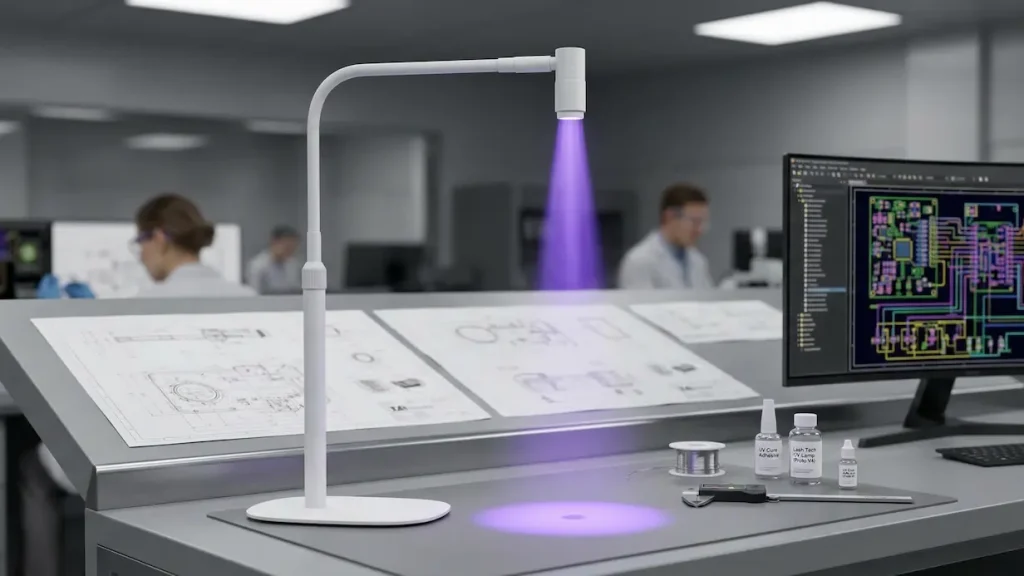
Walk the aisles of any major international beauty expo today, and you will notice a glaring pattern. Hundreds of different brands are showcasing UV lash curing systems that look suspiciously identical. They might feature different logos, slightly altered packaging, or varying colors of plastic housing, but beneath the surface, they share the exact same DNA.
Welcome to the “White-Label Trap.”
Right now, the global lash industry is undergoing a massive shift toward UV technology. Consequently, brand founders and regional distributors are rushing to bring equipment to market. In their hurry, many partner with trading companies or low-tier assembly lines that offer ready-made public molds. You pick a shell, they silk-screen your logo onto the base, and suddenly, you are selling an OEM UV Lash Lamp.
However, let me be entirely blunt from the perspective of a product designer and factory manager who spends hours examining assembly lines and testing materials: Slapping a logo on a generic product is not an OEM strategy. It is a massive liability.
When you build your brand on top of a cheap public mold, you surrender control over your product’s reliability. I see this happen every single week. A brand launches a new lamp, sales spike, and three months later, their inbox floods with angry emails. Customers complain about lamps drifting downward, foot pedals failing, and most dangerously, client retention dropping because the glue suddenly stopped curing properly. Ultimately, the brand takes the blame, while the anonymous factory simply moves on to the next victim.
If you want to build a long-lasting, highly profitable lash brand, you cannot afford to outsource your engineering standards. Sourcing a true OEM UV Lash Lamp requires looking far beyond the plastic exterior. You need to sit down with a true source manufacturer, tear down the product, and customize the Bill of Materials (BOM).
Here is your executive guide to escaping the white-label trap and engineering a product that defends your brand’s reputation.
1. Beyond the Logo: Customizing Spectral Output and Photochemistry
Let’s start with the absolute core function of the device: curing the adhesive.
Currently, a massive marketing war surrounds the “instant cure.” You will see countless white-label vendors boasting about achieving a 0.5-second cure by pushing extremely high electrical wattages. As someone deeply involved in product design, I find this trend alarming because it completely ignores the physics of photopolymerization.
The Reality of the Micro-Drop
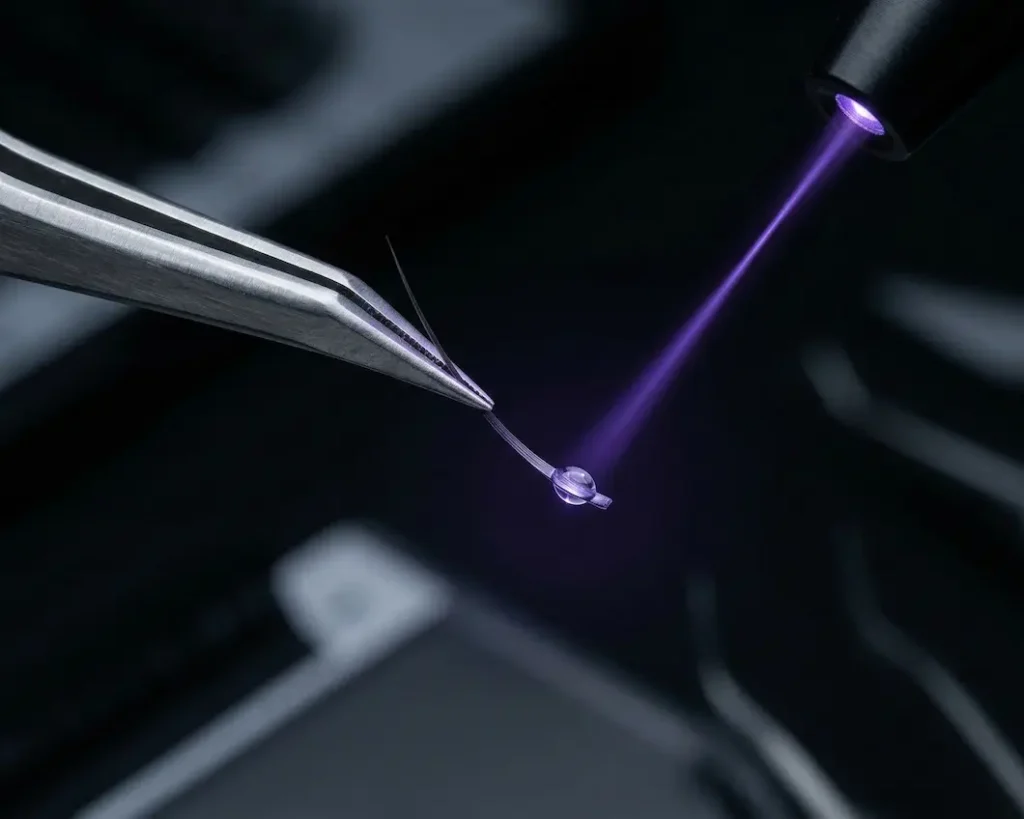
In the lash industry, artists do not use large globs of glue. They use a microscopic amount of cyanoacrylate adhesive—a “micro-drop” that wraps around the base of a 0.03mm extension. Because this volume is incredibly small, you absolutely can achieve a complete, safe cure in 0.5 to 1 second. It is a genuine physical reality. However, you achieve this speed through spectral precision, not through brute-force electrical heat.
The White-Label Spectral Failure
When you buy a public-mold lamp, the factory prioritizes cost reduction above all else. Consequently, they source the cheapest LED diodes available. These low-tier diodes suffer from terrible energy conversion efficiency. When you pump power into them, they generate a massive amount of wasted infrared heat. Yes, the glue might harden quickly, but that uncontrolled thermal energy blasts the client’s eyelid, causing severe “heat spikes” and discomfort.
Furthermore, cheap diodes degrade rapidly. UV photoinitiators in professional lash adhesive react specifically to a narrow wavelength, typically exactly 395nm. When a cheap LED endures the rigorous on-and-off cycling of a busy salon day, its semiconductor materials break down. The wavelength begins to shift. It might drift down to 385nm.
When that wavelength shifts, disaster strikes. The light only partially activates the glue. The outside of the adhesive micro-drop hardens into a shell, but the inside remains a volatile, uncured liquid. We call this a “gummy bond.” The client washes their face, the lashes fall off, and the trapped cyanoacrylate fumes leak out, causing the exact allergic reactions the UV system was supposed to prevent.
The True OEM Standard
When you partner with a legitimate manufacturing facility, we do not just give you whatever diode is cheapest that week. We customize the spectral output. We lock in the exact specifications of the LED chip to ensure absolute wavelength stability and zero lumen depreciation.
As a brand owner, your most critical demand should be consistency. You need the ironclad guarantee that when an artist taps the foot pedal for the 50,000th time, the lamp emits the exact same pure 395nm light as it did on day one. By customizing the optical engine at the BOM level, you protect your clients from heat spikes and protect your artists from retention failures.
2. Mechanical Integrity is Brand Integrity
We spend a lot of time talking about light spectrums and chemistry, but we often forget a fundamental truth: a UV lash lamp is a physical hand tool. Lash artists interact with the hardware physically hundreds of times during a single appointment.
Unfortunately, white-label factories view mechanical parts as prime targets for cost-cutting. They assume that if the lamp looks good in an Instagram photo, the buyer won’t care about the internal metal joints. This approach destroys brands.
The Gooseneck Disaster
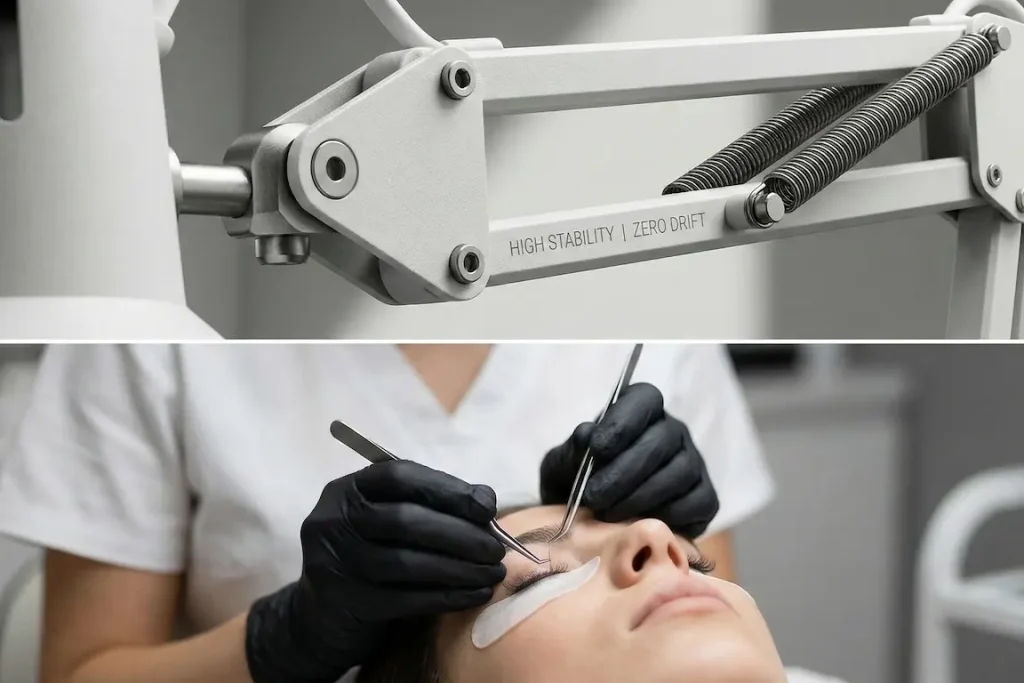
Think about the daily workflow of a master lash technician. They constantly adjust the lamp head, moving it from the left eye to the right eye, pulling it closer, and pushing it away. This continuous movement places immense stress on the gooseneck arm.
Cheap OEM lamps use low-grade, hollow metal tubing with poor internal friction. After a few weeks of heavy salon use, the metal suffers from fatigue. The arm loses its holding power. Suddenly, the heavy lamp head begins to slowly “drift” or droop downward during an appointment. The artist has to stop isolating lashes, grab the lamp, and force it back into position, completely breaking their state of flow. Nothing frustrates a professional faster than fighting with their own equipment.
The Ignition Switch: Foot Pedal Failures
Next, consider the foot pedal. It acts as the ignition switch for the entire curing system. In a white-label setup, factories throw in the cheapest plastic pedals containing fragile, low-budget micro-switches and unstable radio frequency (RF) transmitters.
Salon floors are harsh environments. People step on the pedals, drop tweezers on them, and occasionally spill liquids. A cheap pedal fails quickly under these conditions. Artists start experiencing “latency”—they tap the pedal, but the light delays for a second before turning on. Or worse, they experience “ghost clicks” where the light simply fails to fire.
The True OEM Standard
True product design means obsessing over the physical touchpoints. When customizing an OEM UV Lash Lamp, we engineer the mechanical integrity to match the optical precision.
Instead of generic tubing, we implement high-tension mechanical damping systems within the gooseneck arm. This creates a buttery-smooth adjustment feel that freezes perfectly in place the exact millimeter the artist lets go. Zero drifting, even after thousands of flexes.
For the foot pedals, we upgrade the BOM to include industrial-grade, sealed micro-switches and high-fidelity RF modules. We guarantee a zero-latency, hyper-responsive “tap-to-cure” experience. When you sell a lamp with this level of mechanical stability, your customers instantly feel the premium quality. They recognize it as a professional tool, not a disposable toy, which drastically reduces your RMA rates and skyrockets your brand loyalty.
3. The True Meaning of Customization: Circuit Boards and Electrical Safety
Finally, we must address the invisible brain of the device: the printed circuit board (PCB). You can take two lamps that look absolutely identical on the outside, but their internal circuitry can make the difference between a reliable tool and a dangerous fire hazard.
The Hidden Risks of White-Label Circuitry
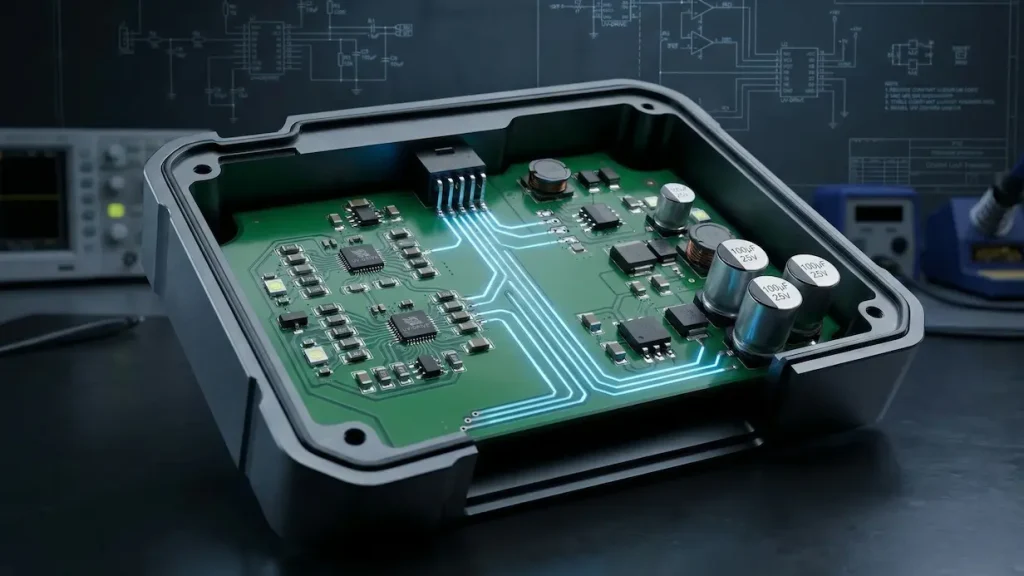
When trading companies sell you a public-mold product, they rarely understand what is happening on the motherboard. To maximize their profit margins, low-tier assembly lines strip the circuit boards down to the absolute bare minimum. They remove essential power-regulation components.
Why does this matter? Because LEDs are incredibly sensitive to electrical current. Without a high-quality constant-current driver on the motherboard, any slight fluctuation in the wall voltage translates directly to the LED diode. This causes the UV light to micro-flicker (which strains the artist’s eyes) and creates inconsistent UV energy output (which leads to unpredictable curing times). Furthermore, lacking proper over-voltage protection puts the entire salon at risk of electrical shorts.
The True OEM Standard
A source manufacturer views the motherboard as the foundation of the entire product. Deep OEM/ODM customization means we design the circuit architecture specifically for your target market.
If you are expanding into Europe or North America, we ensure the internal components meet rigorous CE, FCC, or RoHS compliance standards right from the blueprint phase. We integrate premium constant-current drivers that feed incredibly stable power to the LED, guaranteeing a perfectly smooth, flicker-free UV beam regardless of power grid fluctuations.
When you sit down with a manufacturer who can actually read a circuit schematic and explain their capacitor choices, you know you have found a partner capable of scaling your brand safely.
Conclusion: Choose an Engineering Partner, Not a Printer
The B2B lash industry is maturing rapidly. Five years ago, you might have gotten away with buying a cheap white-label product, printing a logo on it, and selling it through clever social media marketing. Today, the end-users—salon owners and franchise directors—are highly educated. They know what a quality tool feels like, and they severely punish brands that sell them unreliable equipment.
Sourcing an OEM UV Lash Lamp is a strategic business decision that dictates your long-term survival. You cannot afford to fall into the white-label trap.
You need a manufacturing partner who speaks the language of engineering. You need a factory that obsesses over spectral purity, tests mechanical damping for thousands of hours, and customizes circuit boards for absolute stability. You need a team that understands that the 0.5 to 1-second micro-drop cure requires precise wavelength control, not dangerous heat generation.
At Seminglight, we don’t just assemble plastic shells; we engineer professional tools from the ground up. Stop gambling your brand equity on generic public molds. Let’s sit down, review the BOM, and build a proprietary UV lash system that your customers will trust, respect, and reorder for years to come. Start by exploring our UV lash light product range — built to the engineering standards described in this article.
Jim Jiang

Fundador de Seming, diseñador jefe de productos con 20 años de experiencia. Especializado en personalización, innovación y soluciones de iluminación para iluminación fotográfica, iluminación de belleza y herramientas de belleza, y mucho más.