


Introducción
A rising beauty brand owner from California called me last month, and he was sweating bullets.
He had just wired $40,000 to a random supplier he found on a wholesale sourcing website. The order was for a full shipping container of newly branded UV lash lamps. He spent another $15,000 on Facebook ads teasing the launch, pre-sold hundreds of units, and even rented a larger warehouse to handle the volume.
The goods finally arrived at the Port of Los Angeles. But they never made it to his warehouse.
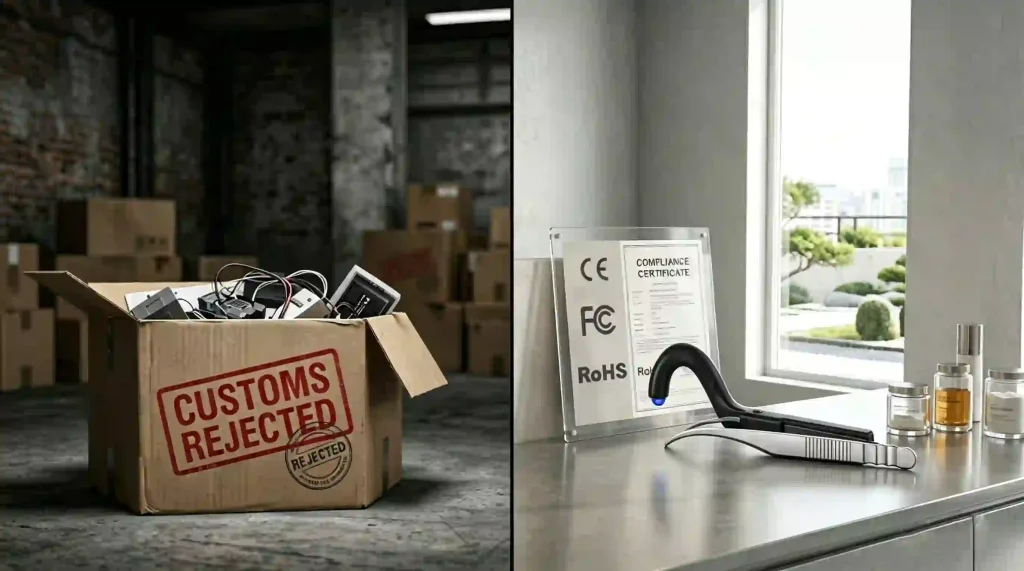
US Customs and Border Protection randomly pulled his container for an X-ray and physical inspection. Finding electronic devices inside, the customs officer asked his freight forwarder to provide the official FCC testing reports and the matching laboratory documentation for the lash lamps.
The brand owner frantically messaged his supplier on WeChat asking for the files. He waited an hour. Then a day. Then three days. The supplier simply stopped replying.
As it turned out, the FCC logos printed on the back of those cheap UV lash lamps were completely fake. The brand owner didn’t just lose his $40,000 inventory deposit. He lost the ocean freight, the marketing spend, and the trust of every single customer who pre-ordered. Customs confiscated and legally destroyed the entire shipment at his expense. His brand almost went bankrupt before the website even went live.
Here is the brutal, unspoken truth of the overseas manufacturing industry: A sticker costs one cent. Real compliance costs thousands of dollars and months of engineering. If you are planning to launch your own private label UV lash system or a premium lash lamp brand, your biggest risk is not your competitor’s marketing strategy. Your ultimate threat is customs compliance and product liability.
Let’s strip away the legal jargon and talk about the visual alphabet soup—CE, FCC, RoHS, and IEC—and why genuine certifications are the ultimate, non-negotiable shield for your UV lash lamp business.
1. The “Photoshop” Epidemic in Cheap Manufacturing
A lot of naive buyers think that if an overseas supplier sends them a PDF file with a “CE” or “FCC” logo on it, their lash lamp is fully protected. This is a fatal business error.
I have toured hundreds of low-end assembly plants in my career. Many of them do not employ a single electrical engineer. When a foreign buyer asks for compliance documents for a new lash light, the factory boss simply asks their graphic designer to Photoshop another company’s test report. They change the date, swap out the model number, and slap the buyer’s brand name on the header.
1.1 How to Spot a Fake Certificate
Customs agents are not stupid; they deal with this every day. A real certification document always comes from an independent, ISO-17025 accredited testing laboratory (like SGS, TUV, or Intertek).
A legitimate certificate has a verifiable report number. You can go to the testing laboratory’s official website, type in that specific report number, and verify if the document actually exists in their database. If your supplier hands you a report from a lab that has no website, no verifiable database, or the QR code goes to a broken link—you are holding a forged document.
When you import these unverified electronic lash lamps, you take on 100% of the legal liability. If that cheap power adapter catches fire in a salon overnight, the victim’s lawyer isn’t going to sue the anonymous factory in Asia. They are going to sue usted, the brand owner.
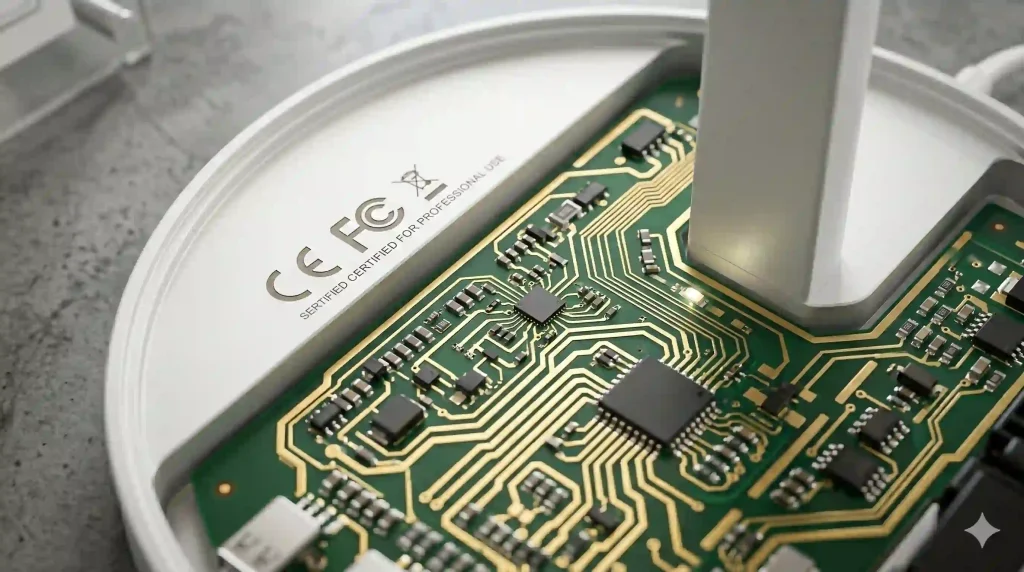
2. Decoding the Compliance Alphabet Soup
To protect your brand equity, you need to understand exactly what these acronyms mean and why customs agents actively look for them.
2.1 FCC: The Invisible Shield (US Market Requirement)
The FCC doesn’t care how bright your UV lash lamp is. They care strictly about electromagnetic interference (EMI). Cheap, poorly designed motherboards and unshielded cables leak massive amounts of “dirty” electromagnetic noise.
If a lash artist plugs in a cheap UV lamp, that leaked energy can disrupt the salon’s WiFi, ruin the Bluetooth connection to speakers, or even interfere with medical equipment. Passing an FCC lab test proves your electronics are properly shielded. US Customs strictly enforces this. No real FCC report? No entry.
2.2 CE: The European Ticket
If you want to sell a lash lamp in Europe or the UK, you need the CE mark. It covers two massive hurdles:
LVD (Low Voltage Directive):
Tests physical electrical safety—if the lamp will electrocute the user or melt down during use.
EMC (Electromagnetic Compatibility):
Europe’s version of the FCC requirement.
2.3 RoHS: The Chemical Guardian (Material Safety)
While CE and FCC focus on electricity and waves, RoHS (Restriction of Hazardous Substances) focuses on what the lash lamp is actually made of. This is where most cheap factories fail.
Lash artists are in close contact with these lamps for hours. If a lamp uses cheap, recycled plastics or low-grade solder, it often contains toxic levels of Lead, Mercury, or Cadmium. When the lamp warms up, these heavy metals can off-gas. A genuine RoHS certification proves that every single component—from the aluminum head to the tiny solder joints—is free from these dangerous chemicals.
3. The Ultimate UV Checkpoint: IEC 62471
If you are launching a UV lash lamp, CE and FCC are only the bare minimum. Because you are dealing with ultraviolet light operating inches away from a human eye, you need the ultimate medical-grade safety document: IEC 62471.
3.1 The Reality of Photobiological Safety Testing
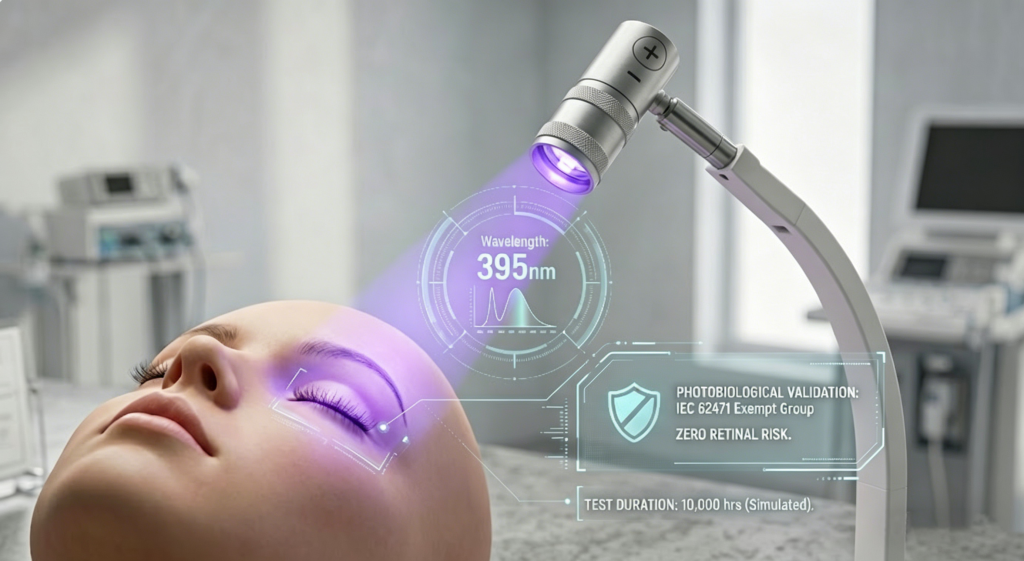
IEC 62471 is the international standard for the photobiological safety of lamps. It measures whether a light source will cause retinal damage or skin burns.
When Seminglight developed our commercial UV lash lamp system, we didn’t guess the safety limits. We submitted our specific 395nm LED arrays to strict laboratory testing. We engineered our diodes to ensure our output falls perfectly within the “Exempt Group” (Zero Risk) for actinic UV hazard. If your supplier stares at you blankly when you ask for the IEC 62471 report, run away. You are playing Russian Roulette with the eyesight of your customers.
4. The E-Commerce Purge and Liability Insurance
Let’s say you miraculously sneak a container of uncertified lash lamps past the border. The nightmare doesn’t end; it just shifts to a more expensive arena.
4.1 The Amazon and Shopify Takedowns
Amazon’s Trust and Safety team will freeze your listing if a competitor files a safety complaint. They will demand official test reports from an ISO-17025 accredited lab within 48 hours. If you upload a Photoshopped PDF, their system will flag it as forged. Your store gets permanently banned, and your inventory is stuck.
4.2 The Product Liability Insurance Trap
To sell to major salon chains, you must carry Product Liability insurance. If you submit fake documents or have none, the insurance company will deny your coverage. Or worse, they will take your premium, but if a lamp catches fire, they will uncover the fake certificates and deny the payout, leaving you personally bankrupt.
5. How Seminglight Engineers for Compliance
At Seminglight, we don’t build a cheap lash lamp and pray it passes a test. We engineer for compliance from the very first CAD drawing.
5.1 It Starts at the Motherboard
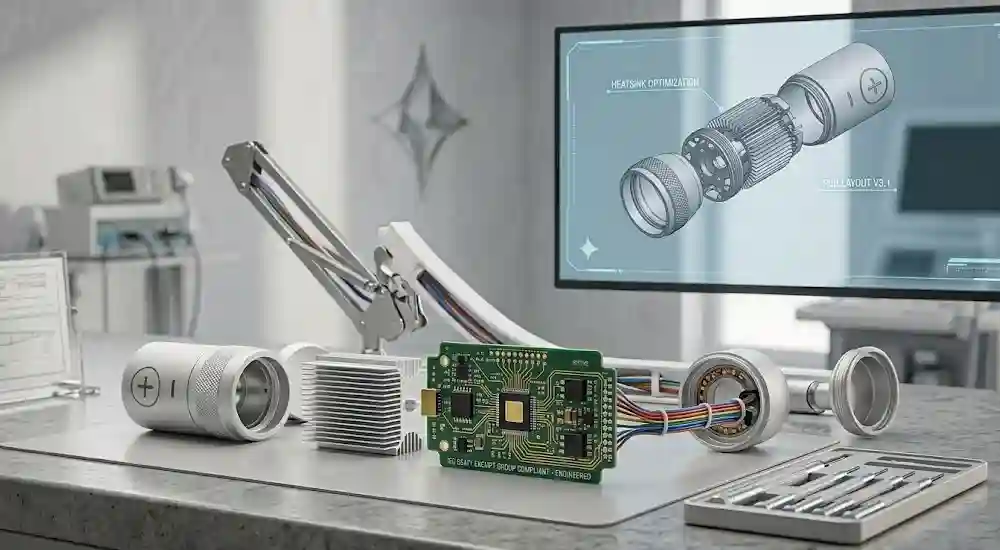
Real compliance starts at the PCB level. While cheap factories use recycled capacitors to save pennies, we integrate heavy-duty, laboratory-grade constant-current motherboards.
We design our own aerospace-grade aluminum heat sinks to manage heat, ensuring the housing never overheats during LVD tests. Because we control the engineering, when we send our lash lamps to labs like SGS or TUV, they pass with flying colors. When you partner with Seminglight, you aren’t just buying metal and LEDs. You are buying an ironclad legal defense.
Conclusion: Stop Playing the Sourcing Lottery and Build a Legacy
Anyone with a few thousand dollars can buy a container of cheap, uncertified lash lamps, throw up a quick Shopify store, and make a fast profit for a few months. But let’s be honest—that is not a real business. That is a ticking time bomb. The exact moment a customs agent flags your container, or a salon owner files an injury complaint, that “business” vanishes overnight.
True brand builders understand a fundamental secret: Strict compliance is not an annoying tax. It is your ultimate competitive moat. Think about it. When your competitors are frantically texting their cheap suppliers because their inventory is seized at the Port of Long Beach, your fully certified, OEM-manufactured products are clearing customs in 24 hours. When their Amazon listings get suspended for safety violations, your premium, RoHS and IEC-backed UV lash lamps are safely climbing to the number one bestseller spot.
At Seminglight, we refuse to be just another hardware vendor. We act as your regulatory firewall. When you partner with us for your private label UV lash lamps, you stop waking up in cold sweats worrying about customs audits, fake FCC stickers, or product liability lawsuits. You get to focus 100% of your energy on what you do best: marketing, building relationships with lash artists, and scaling your empire. We handle the optical physics, the thermal engineering, and the rigorous international legal paperwork.
Building a million-dollar lash equipment brand is entirely possible, but you cannot build a long-term legacy on a foundation of fake PDF certificates and cheap plastics.
If you are tired of playing the overseas sourcing lottery and are finally ready to do things the right way, your next step is crucial. You need to understand the complete A-to-Z process of building a legally compliant, highly profitable brand from scratch.
Stop buying cheap stickers. Start building a legacy.
Jim Jiang

Fundador de Seming, diseñador jefe de productos con 20 años de experiencia. Especializado en personalización, innovación y soluciones de iluminación para iluminación fotográfica, iluminación de belleza y herramientas de belleza, y mucho más.