









1. Das UV-A-Spektrum verstehen: Wissenschaft vs. Panikmache
In der Wimpernbranche weckt der Begriff “UV” oft sofort Bedenken hinsichtlich der Hautalterung und der Augensicherheit. Der Begriff “Ultraviolett” umfasst jedoch einen weiten Bereich von Wellenlängen mit drastisch unterschiedlichen biologischen Wirkungen. Um professionelle Wimpernverlängerungstechniken zu beherrschen, muss man zunächst die Physik des Lichts verstehen und wissen, wie bestimmte Nanometer auf molekularer Ebene mit menschlichem Gewebe interagieren.
1.1. Die Klassifizierung von ultraviolettem Licht und dessen biologische Durchdringung
Ultraviolettlicht wird in drei Hauptbereiche unterteilt: UV-C (100–280 nm), UV-B (280–315 nm) und UV-A (315–400 nm).
1.1.1. Warum 395 nm zur “sicheren Zone” gehört”
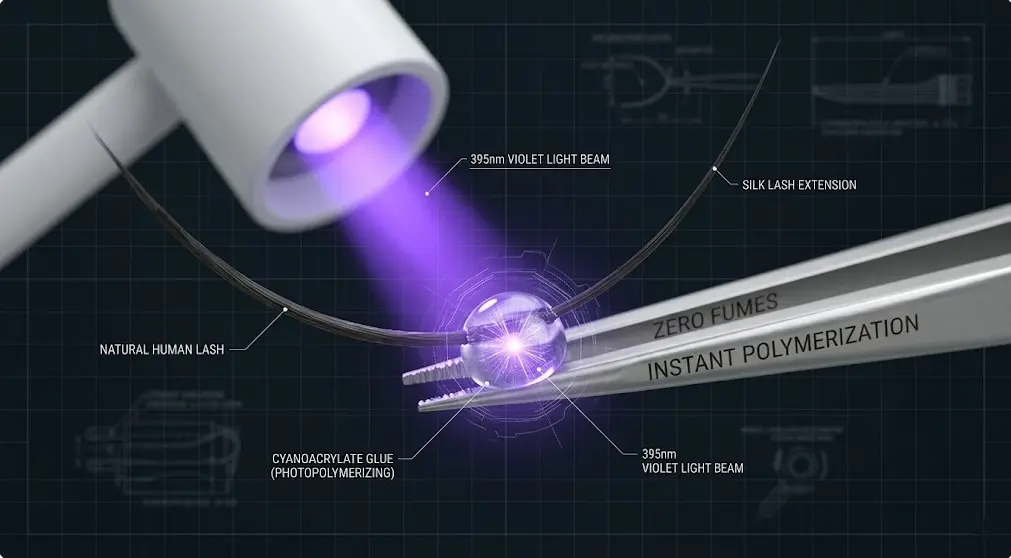
Die Wellenlänge von 395 nm, die in professionellen UV-Wimpernlampensystemen verwendet wird, liegt am äußersten oberen Ende des UV-A-Spektrums und grenzt fast an den Bereich des sichtbaren violetten Lichts. Im Gegensatz zu UV-B, das direkte DNA-Strangbrüche verursacht, oder UV-A im unteren Bereich (320–340 nm), das tief in die Dermis eindringt und Kollagenfasern zerstört, fehlt der Wellenlänge von 395 nm die ionisierende Energie, um tief genug einzudringen und zellulären Stress zu verursachen. Diese Wellenlänge wurde strategisch gewählt, da sie die erforderliche Photonenenergie liefert, um Photoinitiatoren in professionellen Klebstoffen zu aktivieren, ohne dabei die bei kürzeren Wellenlängen auftretenden Werte der “gefährlichen Bestrahlungsstärke” zu erreichen.
1.2. Die Wahl der Wellenlänge: Warum nicht 365 nm oder 385 nm?
Viele industrielle UV-Anwendungen nutzen die Wellenlänge von 365 nm, da diese hochreaktiv und aggressiv ist. In einem Salon, wo sich die Lichtquelle nur wenige Zoll vom Auge entfernt befindet, liegt 365 nm jedoch zu nahe am Spitzenabsorptionsspektrum menschlicher Proteine und Hornhautzellen. Indem wir die “Sicherheitsgrenze” auf 395 nm verschieben, stellen wir sicher, dass die Lichtenergie in erster Linie von den Photoinitiatoren des Klebstoffs absorbiert und von der natürlichen Keratinozytenbarriere der Haut reflektiert oder gestreut wird.
1.3. Photonenenergie und Aushärtungskinetik
Die Energie eines Photons ist umgekehrt proportional zu seiner Wellenlänge ($E = hc/lambda$).
1.3.1. Der „Sweet Spot“ der Technik
Bei 395 nm beträgt die Energie pro Photon etwa 3,14 eV. Dies ist das Präzisionsfenster für RadTech-Standards für die UV-Härtung. Es liefert genügend Energie, um die Doppelbindungen in speziellen Cyanacrylaten für eine sofortige Aushärtung aufzubrechen, jedoch nicht genug, um die photochemischen Reaktionen in der menschlichen Haut auszulösen, die zur Melaninbildung oder zur “Bräunung” führen.
2. Der Irrtum rund um die Nagellampe: Bestrahlungsstärke, Leistungsdichte und Impulsdynamik
Ein weit verbreiteter Irrglaube ist, dass “UV-Wimpernlampen einfach nur Nagellampen auf einem Ständer sind”. Dies ist eine gefährliche Vereinfachung, die die grundlegenden physikalischen Zusammenhänge der “Strahlenexposition” sowie den enormen Unterschied bei der kumulativen Strahlendosis außer Acht lässt.
2.1. Technischer Vergleich: Nagellampen vs. Präzisions-UV-Wimpernlampen
| Technische Merkmale | Standard-UV-Nagellampe | Seminglight UV-Wimpernlampe |
| Belichtungsbereich | Die gesamte Hand und das Handgelenk | 2–3 mm Klebefuge |
| Dauer des Lichts | 60–120 Sekunden (Dauerbetrieb) | 0,5 – 1,0 Sekunden (gepulst) |
| Spectral Width | Broad (365nm – 405nm) | Precision Narrow-Band (395nm) |
| Total Session Energy | ~2,400 – 4,800 Joules | ~15 – 30 Joules (Total) |
| Dermal Impact | Potential Photo-aging | Zero Biological Change |
2.2. The “Pulse” Advantage: Calculating Radiant Exposure ($H$)
Safety in light therapy is defined by the cumulative Radiant Exposure (H=E*t).
2.2.1. Der biologische Schwellenwert als Referenzgröße
A client receiving a full set of lashes is exposed to 395nm light in tiny 0.5-second bursts. Scientifically, the total UV-A dose from a professional session is equivalent to spending less than 3 minutes walking outdoors on a cloudy day. Because the light is highly focused on the adhesive and not the skin, the “Effective Irradiance” on the eyelid is nearly non-measurable by standard dermatological sensors.
2.3. Wärmemanagement und “Kaltvernetzung”
Traditional nail lamps generate significant heat through long exposure, which can cause “heat spikes” in the nail bed.
2.3.1. Kältetechnik in der Luft- und Raumfahrt
A professional UV lash light, due to its pulsed nature and aerospace-grade aluminum heat-sink engineering, maintains a “Cold Cure” profile. This prevents micro-inflammation of the hair follicle and ensures the client feels absolutely nothing during the 0.5s activation.
3. Augenschutz: Die Physik der Strahlkollimation und der Optik
The real danger in light therapy isn’t just the wavelength; it’s the “scatter.” A professional UV-Wimpernlicht must act as a surgical precision tool, not a floodlight.
3.1. Optische Linsenwirkung und kollimierte Strahlen
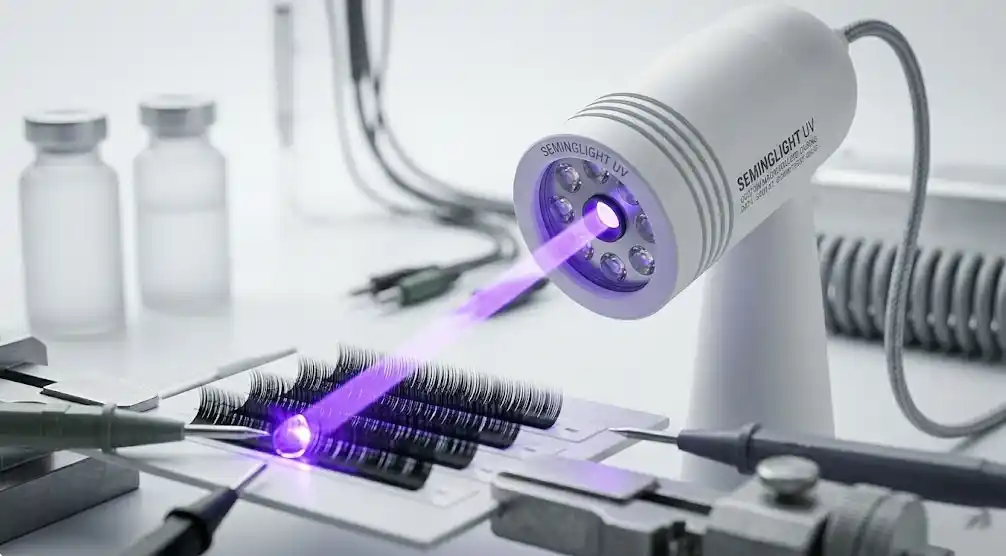
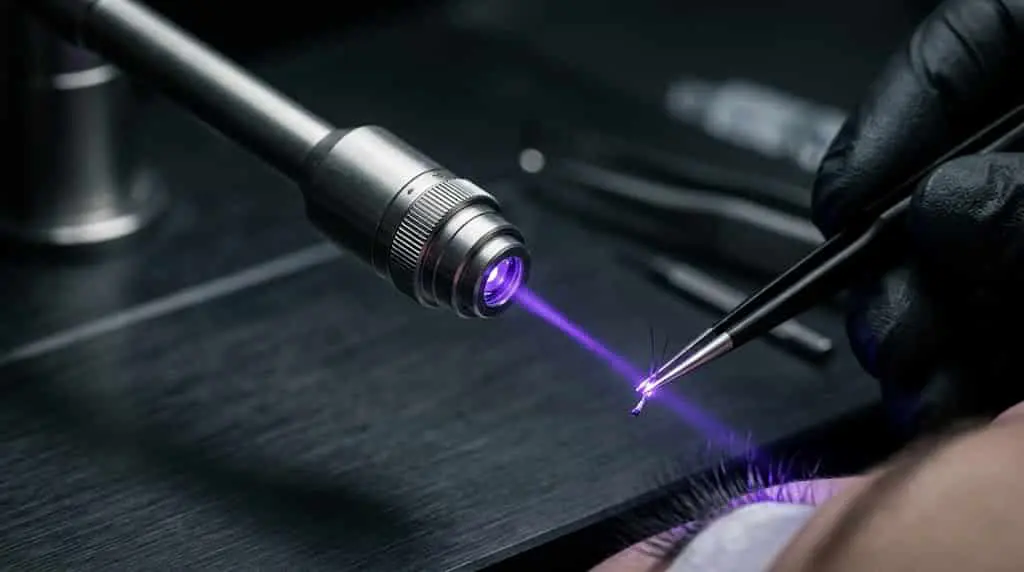
A high-end lamp uses a convex optical lens to create a “collimated beam”—meaning the light rays travel parallel to each other rather than spreading out in a cone shape.
3.1.1. Das Risiko von nicht kollimiertem Licht
Inconsistent beam focus is a major reason why budget lighting hardware fails safety compliance. If the light scatters, it hits the client’s cornea and the artist’s skin. Seminglight’s engineered optics ensure a 98% beam focus on the 2mm target zone, maintaining a “Zero-Leakage” environment.
3.2. Netzhautschutz und Wellenlängenstabilität
3.2.1. Einhaltung der ICNIRP-Standards
Our equipment is designed to stay well within the safety limits established for Non-Ionizing Radiation Protection by international commissions. By ensuring the 395nm wavelength never “drifts” into lower frequencies, we protect the artist from “Blue Light Hazard” and cumulative retinal fatigue.
4. Der Einfluss von “Matte White” auf die optische Sicherheit und das Markenimage
The environment where you work dictates the behavior of every photon emitted by your equipment. This is a core technical pillar of the Matte White Salon Ecosystem.
4.1. Spiegelreflexion vs. diffuse Reflexion (Lambert’sche Oberfläche)
Traditional glossy or chrome-plated lamps create “specular reflection.” This causes light rays to bounce off the equipment at the same angle they hit, essentially turning your workspace into micro-mirrors that redirect 395nm light into the eyes.
4.1.1. Die physikalischen Grundlagen der matten Oberfläche
Our matte white finish acts as a “Lambertian Diffuser.” When a stray photon hits the matte surface, it is scattered in thousands of directions at a lower intensity. This diffuse reflection ensures that even if light accidentally hits your equipment, it is rendered harmless before reaching a human retina.
4.2. Augenermüdung und chronische Lichtbelastung
Continuous exposure to high-contrast glare causes the ciliary muscles in the eye to overwork. This engineering detail sorgt langfristig für klare Sicht by normalizing the light environment.
4.2.1. Reduzierung visueller Störungen
A matte white workspace absorbs and diffuses visual “noise,” providing the lash artist with a stable, high-contrast field of view essential for identifying 0.05mm extensions without chronic eye strain.
5. Der Mythos vom “Altern der Augenlider” – eine Entlarvung: Die quantitative Physik der Sicherheit
Can you get “eyelid wrinkles” from UV lashing? To answer this, we must look at the Inverse Square Law and actual “Radiant Exposure” limits.
5.1. The Inverse Square Law: $I propto 1/d^2$
Light intensity decreases exponentially with distance. In a UV lash setup, the lamp is positioned precisely over the lashes.
5.1.1. Berechnung der Streustrahlungsdosis
Because the light is highly collimated (parallel), the amount of light reaching the eyelid skin from a distance of even 2cm is less than 0.005% of the source intensity. This is far below the “Minimum Erythema Dose” required to trigger melanin production or skin aging.
5.2. Strategie zum Schutz durch Barrieren: Die „Black Patch“-Abschirmung
While the 395nm wavelength is inherently safe, professional protocols utilize physical shielding for absolute peace of mind.
5.2.1. Optische Dichte (OD) von Schutzbarrieren
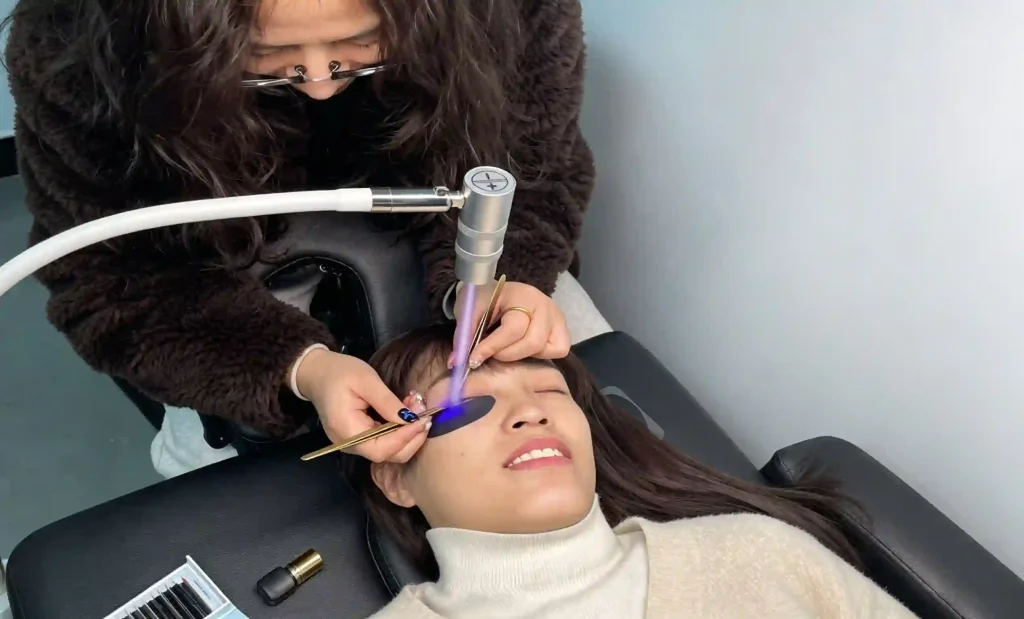
We recommend the use of black under-eye patches with a high Optical Density ($OD > 4$). These patches act as a “Photon Trap,” absorbing 99.99% of incident 395nm light. In a standard session, the skin under a black patch receives less radiation than it would from a standard LED light bulb in a residential home.
6. Weltweite Compliance: Die rechtlichen Fakten zu UV-Geräten
Not all UV lamps are created equal in the eyes of the law. Compliance is the invisible shield that protects your business from lawsuits and customs seizures.
6.1. FCC, CE und RoHS: Mehr als nur Aufkleber
To sell or use a UV device professionally, it must pass electromagnetic interference (EMI) and photobiological safety tests.
Wavelength Drift: Budget lamps often drift +/- 20nm. If a 395nm lamp drifts to 375nm, it is no longer safe for ocular proximity.
Legal Risks: Using uncertified gear can invalidate your salon insurance and lead to equipment confiscation.
6.2. Aufbau einer glaubwürdigen OEM-/ODM-Marke
If you are looking to Develop a Professional UV Lash Product Line, safety documentation is your most valuable asset. Providing your buyers with 3rd-party wavelength verification reports is the only way to build a premium, global brand immune to industry rumors.
Wavelength Drift: Budget lamps often drift +/- 20nm. If a 395nm lamp drifts to 375nm, it is no longer safe for ocular proximity.
Legal Risks: Using uncertified gear can invalidate your salon insurance and lead to equipment confiscation.
6.2. Aufbau einer glaubwürdigen OEM-/ODM-Marke
If you are looking to Develop a Professional UV Lash Product Line, safety documentation is your most valuable asset. Providing your buyers with 3rd-party wavelength verification reports is the only way to build a premium, global brand immune to industry rumors.
7. Fazit: Wissenschaftlich fundierte Autorität ist Ihr bestes Marketinginstrument
The “Truth about UV” is your most powerful weapon against skeptical clients and competitors. When you can explain the difference between a 365nm nail lamp and a 395nm pulsed lash system, you establish yourself as a clinical expert.
Jim Jiang

Gründer von Seming, leitender Produktdesigner mit 20 Jahren Erfahrung. Spezialisiert auf Anpassung, Innovation und Beleuchtungslösungen für Fotografie, Beauty-Beleuchtung und Beauty-Tools und mehr.