









1. The Lash Lift Industry‘s Newest Shift
Lash lifts have been a staple service in salons for years. A good lash lift opens up the eye, makes lashes look longer, and lasts six to eight weeks. It’s a lower-maintenance alternative to extensions.
But lash lifts have always had limitations. Processing times are long. Results vary based on lash condition. And the chemicals involved—thioglycolic acid or cysteamine—are harsh on natural lashes, especially with repeated applications.
Now, UV technology is entering the lash lift space.
UV lash lifts use light-activated formulas that process faster and produce more consistent curls. The technology is still new, and not all artists are familiar with it. But early adopters are reporting processing times cut in half and curl retention that lasts longer than traditional lifts.
This guide covers what UV lash lifting is, how it works, and what you need to know before offering it in your salon.
If you are considering UV equipment for your salon, see our UV lash light collection for professional-grade options.
For a complete guide to UV adhesive application, see our UV lash adhesive guide later in this series.
2. What Is a UV Lash Lift?
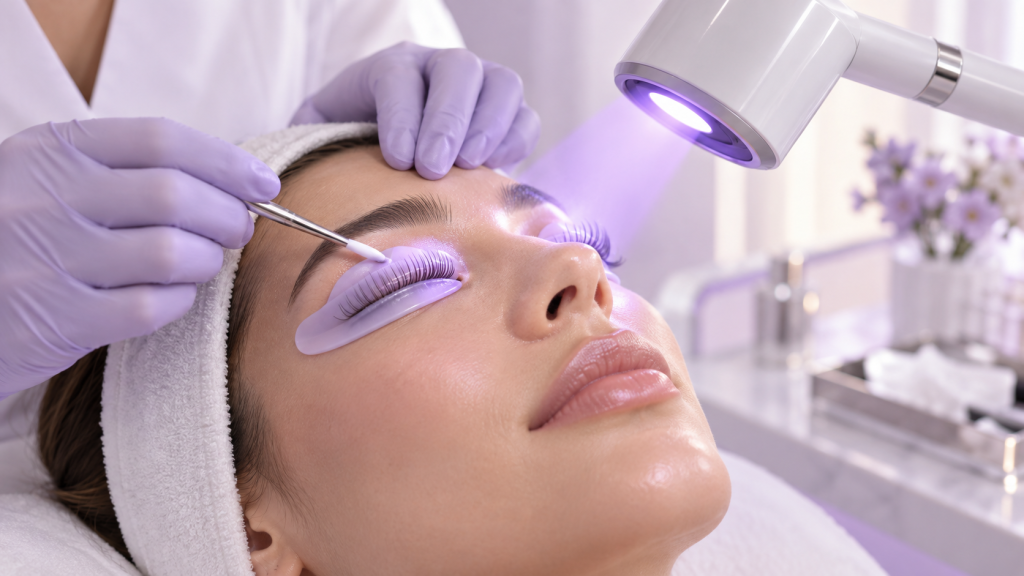
A UV lash lift is a lash enhancement service that uses light-activated formulas to curl and lift natural lashes. Like traditional lash lifts, the goal is to create a lifted, open-eye look that lasts several weeks. Unlike traditional lifts, the processing is triggered by UV light rather than chemical reaction alone.
2.1 How It Differs from Traditional Lash Lifts
| Merkmal | Traditional Lash Lift | UV Lash Lift |
|---|---|---|
| Processing trigger | Chemical reaction (thioglycolic acid or cysteamine) | Light-activated formula + UV light |
| Processing time | 10–15 minutes per step | 3–5 minutes per step |
| Curl consistency | Varies by lash condition | More consistent |
| Over-processing risk | Höher | Nach unten |
| Aftercare restrictions | No water for 24–48 hours | Immediate return to activities |
2.2 The Core Technology
UV lash lift formulas contain photoinitiators that activate when exposed to specific UV wavelengths. When the artist applies the formula and activates the UV lamp, the photoinitiators trigger a controlled reaction that reshapes the lash‘s disulfide bonds.
The key difference from traditional lifts is control. The reaction does not start until the UV light is applied, and it stops when the light stops. The artist controls exactly when and for how long the processing occurs.
3. How UV Lash Lifting Works
The UV lash lift process follows the same basic steps as a traditional lash lift—but with shorter processing times and different formulas.
3.1 The Step-by-Step Process
Step 1: Consultation and Patch Test
Confirm the client is a good candidate for a lash lift. Check for contraindications: recent eye infections, sensitivities to lash products, or very weak lashes that may not withstand the process.
Step 2: Cleansing
Cleanse the lash area thoroughly with an oil-free cleanser. Any oil or residue will prevent the formula from adhering properly.
Step 3: Shield Placement
Apply silicone shields or rods to the eyelids. The size and shape of the shield determines the final curl pattern. Choose a shield that matches the desired lift.
Step 4: Lifting Formula Application
Apply the lifting formula to the base of the lashes. The formula softens the disulfide bonds in the lash structure, allowing them to be reshaped.
Step 5: UV Activation
Activate the UV lamp for the specified time (typically 3–5 minutes). The photoinitiators in the formula trigger the bond-breaking reaction. The UV light ensures a controlled, even process.
Step 6: Setting Formula Application
Apply the setting formula to rebuild the disulfide bonds in their new shape. Activate the UV lamp again for the specified time.
Step 7: Nourishing Serum
Apply a nourishing serum to condition the lashes after processing.
Step 8: Cleanse and Style
Cleanse any remaining product residue. Style the lashes with a lash serum or growth serum if desired.

3.2 Processing Times Compared
| Step | Traditional Lash Lift | UV Lash Lift |
|---|---|---|
| Lifting formula | 10–15 minutes | 3–5 minutes |
| Setting formula | 10–15 minutes | 3–5 minutes |
| Total processing | 20–30 minutes | 6–10 minutes |
| Total appointment | 45–60 minutes | 30–45 minutes |
Our UV lash lights are designed for precise UV activation.
4. The Benefits of UV Lash Lifting
4.1 Faster Appointments
The most immediate benefit is speed. Processing time drops from 20–30 minutes to 6–10 minutes. This means a lash lift appointment can be completed in 30–45 minutes instead of 45–60 minutes.
For salons, this translates to more clients per day. For clients, it means less time in the chair.
4.2 More Consistent Results
Traditional lash lifts depend on chemical reactions that vary based on lash thickness, porosity, and condition. UV-activated formulas process more evenly because the UV light ensures consistent activation across all lashes.
4.3 Lower Over-Processing Risk
Because the reaction only occurs when the UV light is active, there is less risk of over-processing. The artist controls the exact duration of exposure, and the reaction stops when the light stops.
4.4 Immediate Return to Activities
Traditional lash lifts require clients to avoid water for 24–48 hours. UV lash lifts have no such restriction—clients can shower, swim, and exercise immediately after their appointment.
4.5 Longer-Lasting Curl
Early adopters report that UV lash lifts maintain their curl for 6–8 weeks, similar to or slightly longer than traditional lifts. The controlled processing creates a more stable curl pattern that resists relaxing.
5. What to Consider Before Offering UV Lash Lifts
5.1 Equipment Investment
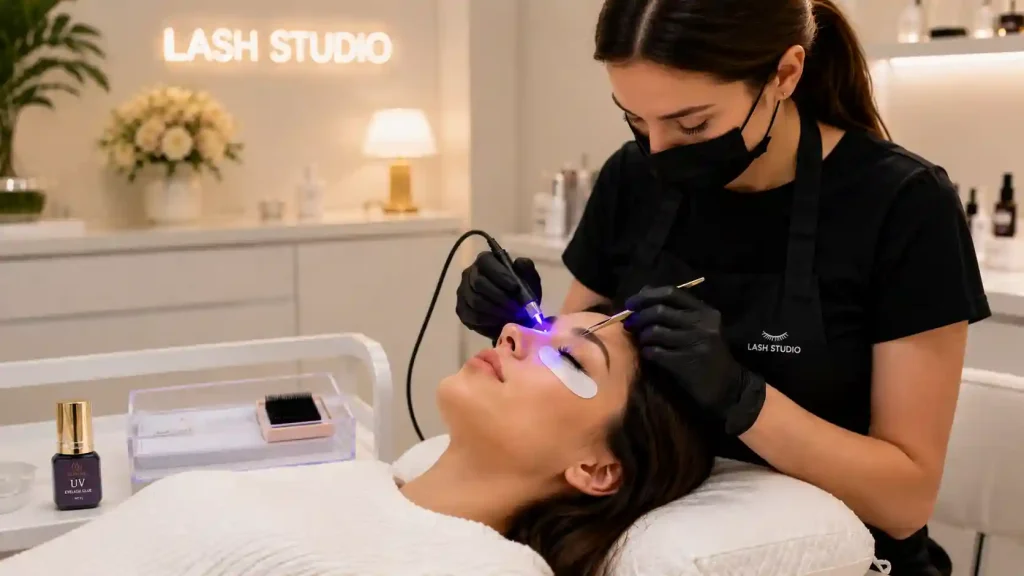
To offer UV lash lifts, you need:
A UV lash lamp (compatible with lash lift formulas)
UV-activated lifting and setting formulas
UV-blocking glasses for client and artist
Proper training
The lamp is the primary investment. Prices range from $80 to $200 for professional-grade models.
5.2 Training Requirements
UV lash lifts require training beyond traditional lash lift certification. The training covers:
UV lamp setup and positioning
UV-activated formula application
Processing time management
Safety protocols
Many lash lift training providers now offer UV-specific modules.
5.3 Client Eligibility
Not all clients are good candidates for UV lash lifts. Contraindications include:
Photosensitivity or photosensitive medications
Recent eye infections or irritations
Very weak or damaged lashes
History of allergic reactions to lash products
Always perform a patch test before the first UV lash lift for any client.
6. UV Lash Lift vs. UV Lash Extensions
Artists often ask: should I offer UV lash lifts or UV lash extensions?
| Faktor | UV Lash Lift | UV Lash Extensions |
|---|---|---|
| Service type | Enhancement of natural lashes | Addition of synthetic lashes |
| Maintenance | No refills needed | Refills every 2–3 weeks |
| Dauer | 6–8 weeks | 3–4 weeks (with refills) |
| Application time | 30–45 minutes | 1.5–2.5 hours |
| Client commitment | Niedrig | Höher |
| Price point | Nach unten | Höher |
| Am besten für | Clients who want natural enhancement | Clients who want fuller, longer lashes |
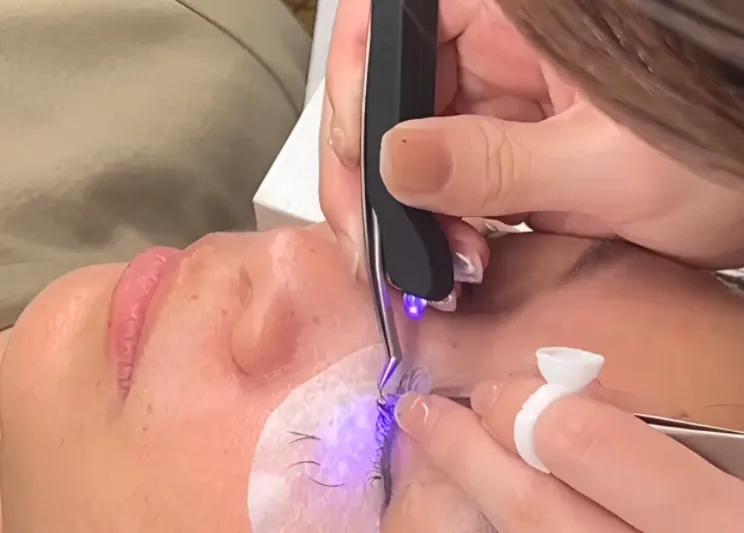
Many salons offer both services. UV lash lifts attract clients who want a low-maintenance enhancement. UV lash extensions attract clients who want dramatic length and volume.
The UV technology works for both—but the equipment and formulas are different. You cannot use UV extension adhesive for lash lifts, or vice versa.
7. Troubleshooting Common UV Lash Lift Issues
| Issue | Likely Cause | Korrektur |
|---|---|---|
| Curl not holding | Processing time too short, formula expired | Increase UV activation time, check formula date |
| Lashes over-processed (frizzy) | Processing time too long, formula too strong | Reduce activation time, use gentler formula |
| Inconsistent curl | Shields not positioned evenly, UV lamp not aligned | Reposition shields, check lamp alignment |
| Client reports irritation | Formula sensitivity, lamp too close | Patch test next time, increase lamp distance |
| Curl too tight | Shield too small, processing time too long | Use larger shield, reduce activation time |
8. Endgültiges Urteil
| Das Wichtigste auf einen Blick | Aktion |
|---|---|
| Faster processing | 6–10 minutes total vs 20–30 minutes traditional |
| More consistent results | UV activation ensures even processing |
| Immediate return to activities | No 24–48 hour water restriction |
| Longer-lasting curl | 6–8 weeks with controlled processing |
| Equipment required | UV lamp + UV-activated formulas |
| Training required | UV-specific lash lift training recommended |
| Client eligibility | Patch test required; contraindications apply |
UV lash lifting is not a replacement for traditional lash lifts. It is an evolution—one that offers faster processing, more consistent results, and a better client experience.
For artists already offering lash lifts, adding UV technology is a natural next step. The equipment investment is manageable. The training is accessible. And the benefits—for both you and your clients—are significant.
For artists who have not yet offered lash lifts, UV technology makes the service more efficient and more profitable. Faster appointments mean more clients per day. Better results mean more referrals.
The lash industry is always evolving. UV lash lifting is the next evolution.
Related UV Lash Reading
- UV lash adhesive vs traditional lash glue
- UV lash training for lash artists
- growing revenue with UV lash services
Eine Notiz von Seminglight – Wir stellen professionelle UV-Wimpernleuchten with 395nm wavelength precision, compatible with UV lash lift formulas. Entdecken Sie unsere UV-Wimpernkollektion oder kontaktieren Sie uns for wholesale pricing and training support.
Jim Jiang

Gründer von Seming, leitender Produktdesigner mit 20 Jahren Erfahrung. Spezialisiert auf Anpassung, Innovation und Beleuchtungslösungen für Fotografie, Beauty-Beleuchtung und Beauty-Tools und mehr.