







1. The Hidden Hierarchy: Why Natural Lash Layers Defy Standard Lighting
In the daily practice of a lash artist, the greatest obstacle to perfection is the inherent complexity of the natural lash cycle. Natural lashes do not grow in a single, neat line; they emerge in a complex, three-dimensional hierarchy of layers, angles, and growth stages. Many artists struggle to achieve a seamless lash map because standard salon lighting often flattens this geometry. A professional Lash Mapping Light is not just about brightness—it is about spectral clarity and shadow control. When you cannot clearly distinguish the primary, secondary, and tertiary layers, you are essentially grafting blind. This leads to the most common frustration in the industry: the “redo.”
The professional lash industry has evolved from a craft rooted in manual patience to a discipline grounded in precision engineering and high-fidelity optics. Today, the quality of the final result—the lash map—remains entirely dependent on the artist’s ability to see and isolate the natural lashes. This article delves into the technical, spectral, and optical principles that define how high-CRI (Color Rendering Index) lighting serves as the primary tool for revealing the natural lash hierarchy.
2. The Science of the “Redo”: Efficiency and Grafting Rates
A “redo”—the need to remove and reapply a lash extension due to poor placement or improper layer isolation—is the silent killer of salon profitability. It increases service time, strains the client’s natural lashes, and creates significant physical fatigue for the technician.
2.1. Revealing the Layers with High-CRI Optics
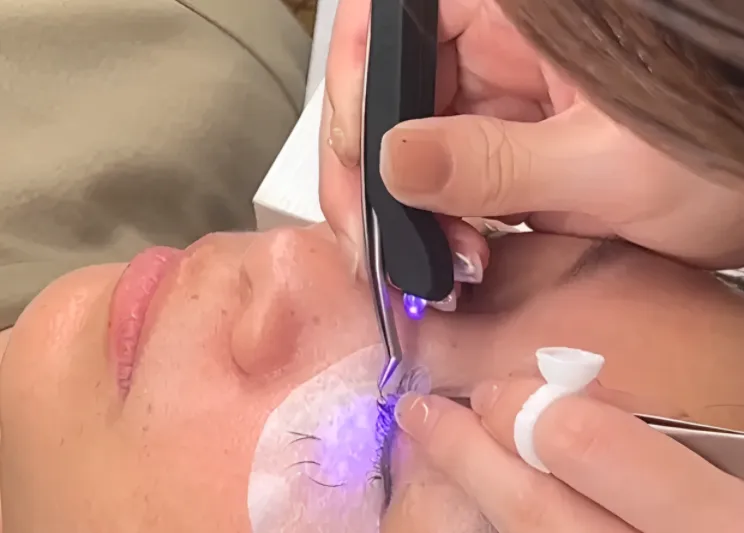
The core challenge in mapping is the lack of contrast. Natural lashes, especially those that are fine or blonde, are notoriously difficult to see under low-CRI, yellow-tinted salon lighting. By leveraging Precision Tweezer Lamp technology, you utilize a light source with a CRI of 95+. This spectral accuracy mimics natural daylight, which is the only environment where the subtle differences in lash diameter and hair cuticle texture become visible.
2.2. Mapping the Efficiency Gap
When you can distinguish a baby lash from a mature lash layer, you no longer need to “guess” where to place your extension. A high-quality Lash Mapping Light provides the collimated illumination necessary to cast micro-shadows behind each individual hair. These shadows act as visual guides, allowing the artist to instantly identify the specific layer a lash belongs to, thereby reducing the incidence of “stickies” and misplaced extensions that require correction later.
Technical Performance Matrix: Grafting Efficiency
| Metrisch | Standard Salon Lighting | Precision Lash Mapping Light (CRI 95+) |
| Layer Visibility | Low (Flattened detail) | High (3D Depth Perception) |
| Redo Frequency | 15% – 20% of service | Under 5% |
| Grafting Speed | Variable (Corrective focus) | Consistent (Proactive focus) |
| Technician Fatigue | High (Visual strain) | Low (Optimized visual field) |

3. High CRI Lighting: The Artist’s Visual Lens
The term “High CRI” (Color Rendering Index) is frequently misused in consumer lighting, but for a professional Lash Mapping Light, it is a non-negotiable metric. CRI-95+ lighting provides the spectral accuracy required to distinguish between fine vellus hairs, emerging baby lashes, and mature growth stages.
3.1. Spectral Clarity and Mapping Design
As you dive into the intricacies of modern adhesive science, you realize that your eyes must be as precise as your chemistry. When the light output mimics the full spectrum of daylight, it prevents the “color washing” effect that obscures the natural lash’s true texture. This spectral clarity is the cornerstone of high-retention lashing protocols, allowing you to map and isolate lashes with unprecedented accuracy. By revealing the hidden hierarchy of the lash line, you can design “advanced layering” maps that were previously considered impossible, such as blending thicknesses to create a softer, more dimensional look.
4. Engineering as a Career Protector
Your career longevity is tethered to your eyesight and posture. Standard, non-collimated light forces the artist to constantly shift their torso and neck to “find the angle” where the lash becomes visible against the glare.
4.1. Visual Ergonomics and Health
A precision-engineered Lash Mapping Light significantly reduces visual strain by providing a consistent, flicker-free field of view. When your light is designed for the artist, you no longer need to lean forward in an awkward “lash-hunch” to isolate a hidden lash layer. This proactive ergonomic support is the ultimate tool for preserving your career and maintaining your high standard of work for years to come.
5. Strategic Implementation: Elevating Your Mapping Design
Advanced lash mapping requires a 3D understanding of the eye. A Lash Mapping Light is not just a tool; it is a diagnostic instrument.
5.1. Building a Competitive Moat
Your salon is no longer just “applying lashes”—you are executing a precise, technology-driven procedure. This shift justifies higher price points. According to Supply Chain Management Professionals (CSCMP), salon brands that control their technical stack have significantly higher barriers to entry against competitors. Furthermore, adhering to OSHA lighting guidelines for your professional workspace ensures safety for both you and your clients.
5.2. Standardization and Scalability
For salon owners and brand builders, standardizing the lighting protocol is the most effective way to eliminate operational variance. When your hardware is technically aligned with your mapping protocol, you remove the biggest variable in your customer service experience. A salon that can guarantee uniform, perfect mapping for every client, regardless of which artist is performing the service, will naturally command premium pricing.

6. Comprehensive Technical Deep-Dive: The Optics of Mapping
To truly achieve professional lash mapping, one must look at the way light interacts with the lash structure.
6.1. The Architecture of the Map
The goal of a map is to create a transition of lengths and curls that complements the client’s eye shape. When the light source has a hoher CRI, it reveals the natural “lift” or “droop” of individual lash layers. This allows the artist to compensate for these variances in real-time, placing extensions in a way that creates a perfectly even lash line regardless of the natural growth pattern.
6.2. Thermal Regulation and Client Safety
One of the most frequent misconceptions in UV lashing is that higher intensity means higher heat. In reality, modern wireless lash solutions use sophisticated thermal management systems to ensure the energy remains focused on the photonic reaction, rather than generating excessive heat. This protects the delicate eyelid skin while accelerating the curing timeline.
7. Scaling Your Salon: The Advanced Mapping Workflow
Adopting a precision-focused workflow requires a change in your operational mindset. You are shifting from a humidity-controlled mindset to a light-controlled mindset.
7.1. Training for the Future
Technicians must be trained to use the light as an active, not passive, tool. This involves:
Distance Management: Maintaining the correct distance to ensure irradiance density is optimal for the current lash layer.
Angle Optimization: Adjusting the light head to highlight the specific lash layer being worked on.
System Maintenance: Recognizing that even a slight misalignment in optics can drastically alter the visibility of fine lash fibers.

8. Conclusion: Perfecting the Art of the Map
The perfect volume lash set is the intersection of manual artistry and high-precision engineering. By shifting your focus toward mapping precision, high-frequency light interactions, and optimal visual clarity, you can permanently solve the issue of fan closure and unlock new levels of retention. This evolution in your technical stack is exactly what elevates an artist to an industry-leading entrepreneur.
If you are ready to modernize your salon and standardize your results, explore our wireless lash solutions. Master the light, see the layers, and set a new standard for your brand.
Jim Jiang

Gründer von Seming, leitender Produktdesigner mit 20 Jahren Erfahrung. Spezialisiert auf Anpassung, Innovation und Beleuchtungslösungen für Fotografie, Beauty-Beleuchtung und Beauty-Tools und mehr.