







1. The Chemistry Behind the Cure
Professional lash artistry is undergoing a massive technological shift. For years, lash artists relied on slow-drying adhesives vulnerable to environmental humidity. Today, the game has changed. The implementation of 395nm UV lash adhesive curing represents a fundamental upgrade in how we handle lash bonding .
By moving away from atmospheric moisture dependence and embracing light-initiated polymerization, technicians can achieve results that were previously impossible. This transition is not just about adopting a new tool—it is about embracing a new chemical reality . When you align your hardware with the precise wavelength required by advanced adhesives, you create a service experience that is faster, more durable, and significantly more professional .
This guide explains the science behind 395nm UV lash adhesive curing: how photo-initiators work, why wavelength matching matters, and how the 395nm “sweet spot” delivers the perfect balance of speed, safety, and bond integrity.
Explore UV lash lights with 395nm precision.
For the business case behind UV adoption, see our ROI guide for salons.
2. Photo-Initiators: The Chemical Receiver
To understand why 395nm matters, you must first understand what happens at the microscopic level during the curing process.
Modern UV adhesives contain photo-initiators—light-sensitive molecules engineered to remain dormant until they are exposed to the exact energy threshold they require . These molecules are the “receiver” in the chemical system. The light source is the “transmitter.” If the signal does not match the frequency of the receiver, nothing happens .
Every photo-initiator has an absorption curve—a narrow band of wavelengths that effectively triggers the polymerization chain reaction . When a photo-initiator absorbs a photon of the correct wavelength, it decomposes into free radicals. These radicals then attack the double bonds of acrylate monomers, initiating a chain reaction that converts liquid resin into a solid, cross-linked polymer matrix in seconds .
The selection of the photo-initiator is critical for safety and efficacy. Industrial-grade formulations use initiators tuned specifically to the output of LED curing lamps to ensure exhaustive curing and minimal residual monomers .
UV lash lights with 395nm wavelength precision ensure photo-initiator activation.
3. The 395nm Sweet Spot: Why This Wavelength?
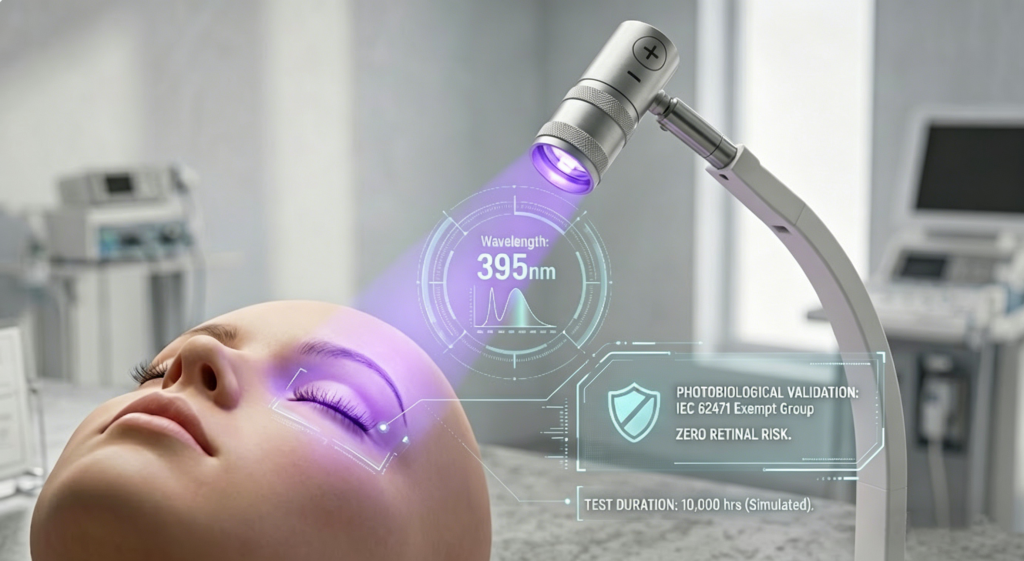
The industry standard for UV lash adhesives is 395–405 nanometers (nm). Professional UV lash lamps typically operate at 395–400 nm , while some adhesives are designed for 365–395 nm . The “sweet spot” is 395nm.
Why 395nm?
If the wavelength is too high (400nm+): The energy may be insufficient to trigger a full, dense cross-linking of the polymer chains .
If the wavelength is too low (360nm-380nm): The energy may be too aggressive, potentially causing “blooming” (white residue) or brittle bond failure due to surface-skinning .
At 395nm: Extensive industry testing shows that 395nm provides the perfect balance of energy density and penetration depth, ensuring the adhesive cures from the inside out, not just at the surface .
Locks Lash, a leading lash industry educator, explains: “UV glue only hardens when it ‘sees’ the right type of light. Not all machines emit the same type of light. If the incorrect light is emitted for that specific glue, it won’t cure and you will get a weak bond and bad retention” .
The guidance is simple: always check what wavelength the glue needs and what wavelength the lamp produces. If they don’t match, the system won’t work properly, even if both are “high quality” on their own .
4. Wavelength Comparison: 365nm vs. 395nm vs. 405nm
| 波长 | Common Use | 优点 | 缺点 |
|---|---|---|---|
| 365纳米 | Industrial UV, nail curing | Highly reactive, aggressive | Too close to protein absorption peak—eye safety concerns |
| 395纳米 | Professional lash adhesives | Perfect energy balance, deep penetration, no “blooming” | Requires matched adhesive |
| 405nm | Some lash adhesives | Cures effectively | Slightly higher energy—may not penetrate as deeply |
5. Collimated Light: Precision Over Scatter
Wavelength is only half the equation. How the light is delivered is equally important.
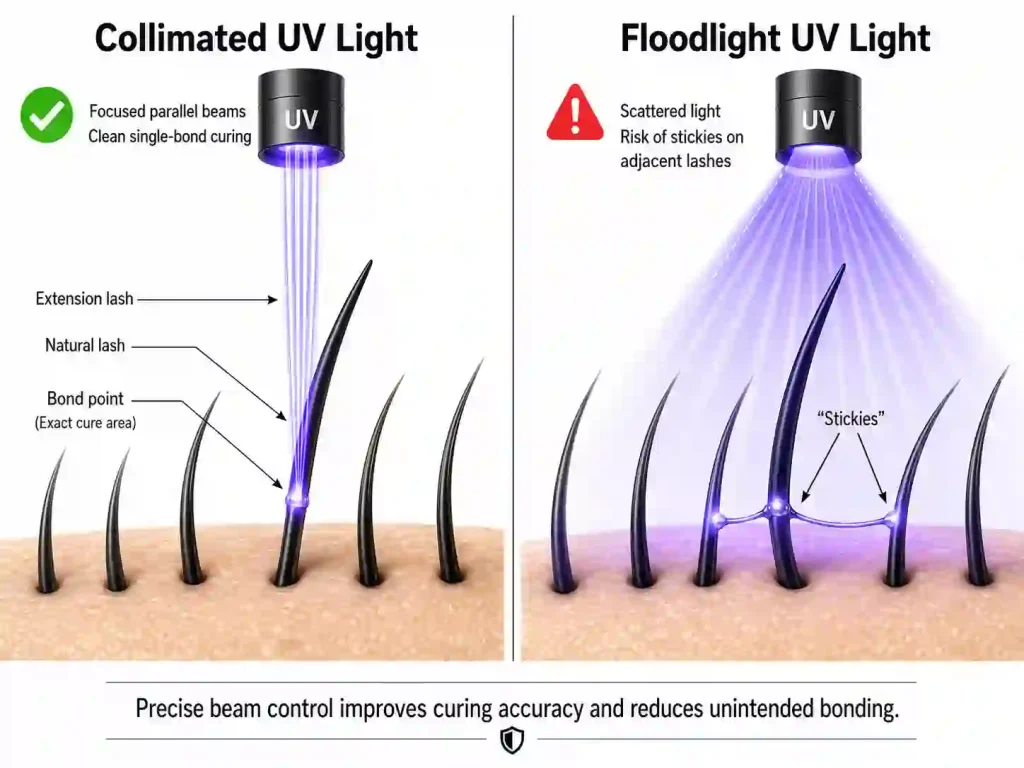
Many salon owners believe that any UV light will work with UV lash adhesives. This is a common and expensive mistake. Effective 395nm UV lash adhesive curing requires a hardware-chemistry handshake. If your hardware does not provide a stable, collimated beam, you will encounter significant issues .
Collimated light travels in parallel rays rather than scattering in all directions. When you use a device that projects collimated light, you keep the energy concentrated on the individual bond point. This prevents “stray light” from curing adhesive on adjacent lashes—the primary cause of “stickies” and messy fan structures .
The difference:
| Beam Type | UV Distribution | 结果 |
|---|---|---|
| Floodlight (scattered) | UV spreads across the eye area | Wasted energy, risk of skin exposure, slower cure |
| Collimated (focused) | UV concentrated on the bond point | Faster cure, no “stickies,” safer |
According to Seming’s technical analysis, a standard overhead UV lamp is often inefficient because it wastes energy scattering light across the entire eye area. By concentrating the 395nm output directly at the bond point, the hardware maximizes “irradiance density” .
6. The Science of Polymerization: How 395nm Triggers the Cure
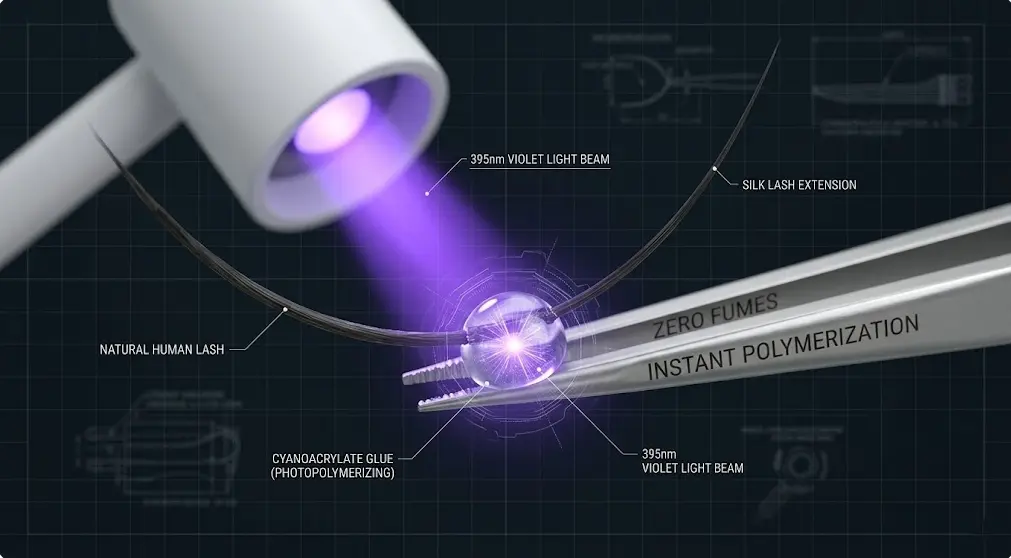
When the light hits the adhesive at the 395nm frequency, several things happen in rapid sequence :
Absorption: Photo-initiator molecules absorb the 395nm photon energy
Free radical formation: The photo-initiator decomposes into free radicals
Chain reaction: Radicals attack the double bonds of acrylate monomers
Cross-linking: Liquid resin transforms into a solid polymer lattice
Full cure: The process completes in 0.5–3 seconds
结果是 A high-density polymer lattice that is durable yet flexible enough to move with the natural lash, significantly improving client retention .
Professional UV adhesives achieve full structural integrity in 1.0 to 3.0 seconds upon exposure to a calibrated LED source with minimum irradiance of 50mW/cm² .
7. UV Adhesive Specifications
Engineered UV lash glues are sophisticated chemical formulations designed for high-performance cross-linking :
| Specification | Professional Standard | 为何这很重要 |
|---|---|---|
| Curing wavelength | 365–395nm or 395–405nm | Must match lamp output |
| Viscosity | 50–150 cPs | Precision placement without “wicking” |
| Cure time | 1.0–3.0 seconds | Requires calibrated LED source |
| Thermal stability | -40°C to +80°C | Post-cure resistance |
| Unopened shelf life | 12 months | Proper storage required |
| Opened shelf life | Minimum 3 months | When stored correctly |
According to UV adhesive suppliers, once dispensed, the glue drop can be sensitive to direct or reflected UV/LED light, heat, lamp distance, and reflective surfaces . Professional lash artists should keep the adhesive drop away from the direct lamp beam and stray reflections, use smaller fresh drops more frequently, and keep the bottle capped between uses .
Browse our UV lash curing lamps with matched wavelength output.
8. Common Mistakes and How to Avoid Them
| 错误 | 为什么会痛 | How to Avoid |
|---|---|---|
| Using any UV lamp with any UV glue | Wavelength mismatch = weak bonds | Match lamp wavelength to glue specs |
| Buying cheap, “floodlight” lamps | Stray light causes “stickies” | Choose collimated/focused beam |
| Placing glue drops in direct UV light | Premature curing on the palette | Keep glue away from lamp beam |
| Allowing adhesive to “skin over” before curing | Shell cure—weak internal bond | Cure immediately after placement |
| Ignoring lamp maintenance | Wavelength drift over time | Replace lamp heads per specs |
According to Locks Lash, “If they don’t match, the system won’t work properly, even if both are ‘high quality’ on their own” .
9. 最终裁决
| 关键要点 | 行动 |
|---|---|
| 光引发剂 | Match your lamp wavelength to the adhesive’s absorption curve |
| 395nm sweet spot | Use 395nm for the perfect balance of speed, safety, and bond integrity |
| Collimated light | Choose focused beam over floodlight to prevent “stickies” |
| Hardware-chemistry synergy | Your lamp and glue must be designed to work together |
| 安全 | 395nm is the “safety bottom line” for close-proximity eye applications |

Mastering the technical side of lash artistry is not easy, but it is necessary for success . The synergy between precise hardware and high-performance adhesives is the secret to scaling your brand and increasing your profitability .
When your light source operates at the exact peak absorption of the adhesive’s photo-initiators, you move from “hope-based curing” to scientific precision . Your investment in high-quality hardware is a statement to your clients that you care about their results, their time, and the integrity of a high-performance salon .
来自 Seminglight 的说明 – 我们生产专业级 紫外线睫毛灯 with 395nm wavelength precision and collimated beam optics. 探索我们的UV美睫系列 或 联系我们 for wholesale pricing.