





Informazioni sull'autore: Jim Jiang
Fondatore di Seming, Chief Product Designer con 20 anni di esperienza.
Specializzata nella personalizzazione, nell'innovazione e nelle soluzioni di illuminazione per la fotografia, l'illuminazione di bellezza, gli strumenti di bellezza e altro ancora.
1. The Question Every Lash Artist Eventually Asks
You‘ve been working with traditional lash adhesive for years. You know its quirks—the way it behaves in high humidity, the way it shock-cures when the room is too damp, the way your retention drops in summer and improves in winter.
Then a colleague mentions UV adhesive. “It cures with light, not humidity,” she says. “You press a pedal, and the bond sets instantly.”
It sounds too good to be true. Or maybe you‘ve already tried UV and wondered if it‘s worth switching your entire workflow.
This comparison cuts through the marketing claims. It looks at the actual chemical difference, the practical impact on your application process, and the retention outcomes that matter for your business.
2. The Chemistry: Two Different Trigger Mechanisms
The core difference between UV adhesive and traditional lash glue comes down to one thing: what triggers the curing reaction.
2.1 Traditional Cyanoacrylate Glue: Humidity-Triggered
Traditional lash adhesive is cyanoacrylate-based. It cures when it contacts moisture—specifically, the microscopic water molecules present on the natural lash surface and in the air.
This is called anionic polymerization. The water molecules act as the initiator, triggering a chain reaction that converts liquid monomers into a solid polymer. The reaction starts the moment the glue is exposed to air and continues for 24–48 hours.
The practical problem: you can‘t control the trigger. If the room is too dry (below 40% RH), the glue cures too slowly—stickies form, and placement becomes difficult. If the room is too humid (above 65% RH), the glue cures too fast—shock polymerization creates a brittle, shell-like bond that shatters under stress .
2.2 UV Adhesive: Light-Triggered
UV lash adhesive contains the same cyanoacrylate base, but with one key addition: photoinitiators .
Photoinitiators are molecules that remain dormant until they absorb light at a specific wavelength—typically 365nm or 395–405nm. When the lash artist activates the UV lamp, the photoinitiators absorb the light energy, decompose into reactive species, and trigger instant polymerization .
The critical difference: you control the trigger. The adhesive stays liquid until you press the pedal. No racing against drying time. No humidity guesswork .
3. The Practical Comparison: What Changes in Your Workflow
| Fattore | Traditional Cyanoacrylate | UV/LED Adhesive |
|---|---|---|
| Innesco della cura | Ambient humidity (H₂O) | Light (photoinitiators + wavelength) |
| Tempo di indurimento | 0.5–2 seconds (gradual over 24 hrs) | 1–3 seconds (instant, fully cured) |
| Humidity dependence | High—strict RH% control required (45–60% optimal) | Low to none—works regardless of room conditions |
| Working fumes | Off-gasses continuously while curing | Minimal off-gassing post-flash |
| Shock curing risk | High if humidity spikes above 70% | Zero—cure is controlled by light, not air |
| Stickies risk | High—if you don‘t work fast enough | Zero—cure on command eliminates stickies |
| Post-service wait | 24–48 hours before getting wet | Immediate—can get wet right away |
| Removal | Standard cream/gel removers | Requires system-specific removers |

According to London Lash UK, the underlying acrylate chemistry remains the same in both systems. The light simply changes the initiator trigger, not the core chemical family . This means UV adhesive is not “glue-free”—it‘s the same adhesive family with a different curing mechanism.
4. Retention: Does UV Actually Last Longer?
This is the question that matters most. If UV adhesive doesn‘t improve retention, the switch isn‘t worth the investment.
4.1 The Retention Reality
According to Paris Lash Academy, most clients using UV lash extensions gain roughly an extra week of wear per cycle compared to traditional lashing . The key phrase is “roughly”—it‘s not a guarantee, and results vary by client growth cycle.
The retention improvement comes from two factors:
1. Fully cured bonds from day one. Traditional adhesive continues curing for 24–48 hours after application. During this window, water exposure, oil, or mechanical stress can compromise the bond before it reaches full strength. UV adhesive is fully polymerized before the client leaves the chair .
2. Humidity independence. Traditional adhesive behaves differently in summer and winter. UV adhesive delivers consistent results regardless of season or room conditions .
4.2 What Retention Looks Like in Practice
| Tipo di adesivo | Typical Retention (with proper prep) |
|---|---|
| Fast-cure traditional (1–2 sec) | 6–8 weeks |
| Medium-cure traditional (2–3 sec) | 5–7 weeks |
| Slow-cure/sensitive traditional | 4–6 weeks |
| UV/LED adhesive | +1 week compared to traditional |
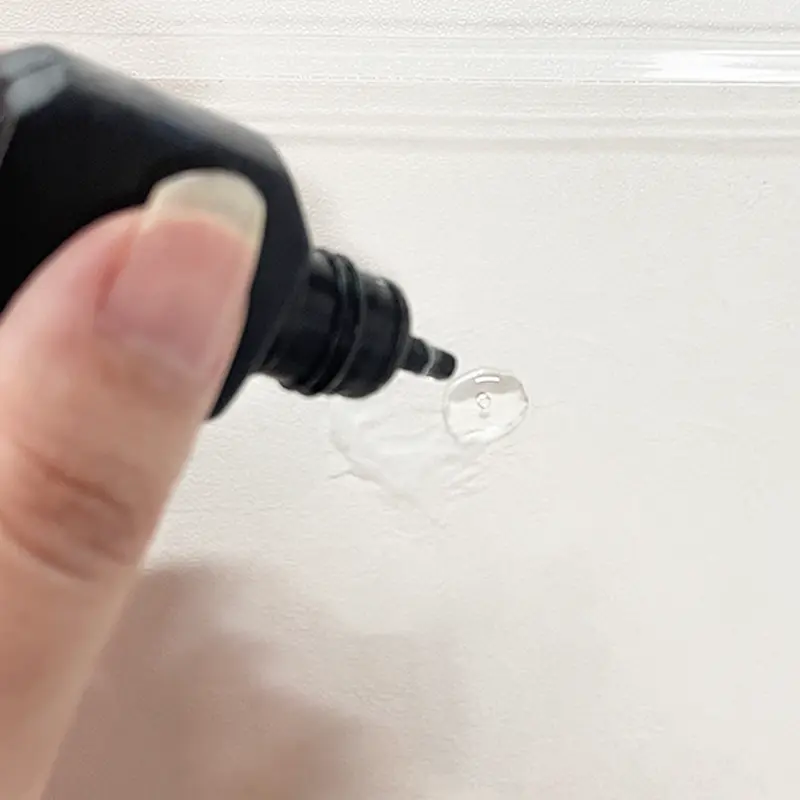
The “+1 week” figure comes from Paris Lash Academy‘s clinical observation. Baby lashes from the previous appointment tend to hold their bond longer, keeping the lash line fuller and more complete between fills .
4.3 What UV Does Not Fix
UV adhesive is not a miracle cure for poor prep or bad technique. According to Swaniya Lashes, most retention failures trace back to one root cause: oil contamination or incorrect humidity . If the natural lash isn‘t properly cleansed, the bond will fail regardless of the adhesive system.
London Lash UK confirms this: “Natural lash prep and cleanliness remain vital; oil or dust on the natural lash will still break the bond regardless of cure method” .
5. The Fume and Sensitivity Question
One of the most common reasons artists consider UV adhesive is client sensitivity. Here‘s what actually changes—and what doesn‘t.
5.1 Reduced Fume Exposure
Traditional cyanoacrylate adhesive off-gasses continuously while it cures—a process that continues for 24–48 hours after application. These fumes are the primary cause of eye stinging, redness, and irritation during and after the service .
UV adhesive cures almost instantly. The time window for monomer off-gassing drops sharply. According to London Lash UK, “UV LED adhesives tend to have lower volatile organic compound levels and cure quickly, which minimizes the fume contact that causes irritation” .
5.2 The Allergy Reality
Here‘s what marketing materials often gloss over: UV adhesive is not allergen-free.
All lash adhesives on the market are acrylate-based. UV-curing adhesives still contain cyanoacrylate. If a client has a true medical allergy to the acrylate family, UV adhesive may still trigger a reaction .
What UV adhesive does reduce is fume exposure. This helps clients who react to fumes—but not clients with a genuine cyanoacrylate allergy. According to Belle Ame Skin & Beauty, “UV adhesive may significantly reduce irritation for clients reacting to fumes, but it will not help someone who has developed a true cyanoacrylate allergy” .
6. Cost and Equipment: What‘s the Real Investment?
Switching to UV adhesive requires more than just buying a different bottle of glue. Here‘s what you need:
| Articolo | Traditional Setup | UV Setup |
|---|---|---|
| Adhesive cost | Lower per bottle | Higher per bottle |
| Lamp system | None required | Required (LED/UV curing lamp) |
| Protezione degli occhi | Standard | UV-blocking glasses for client and artist |
| Formazione | Standard | Required for proper use |
The lamp system is a one-time investment. Professional UV lamps typically last 5,000–6,000 hours of active use. At typical salon usage (2–4 hours of active curing per day), that‘s 2–3 years of service.
7. When UV Adhesive Makes Sense (and When It Doesn‘t)
7.1 UV Adhesive Is Worth It If:
You work in high humidity or variable climates. UV adhesive eliminates the seasonal retention swings that plague traditional lashing .
You have clients with fume sensitivity. The reduced off-gassing helps clients who react to traditional adhesive fumes .
You want consistent results. UV adhesive removes the humidity variable, making your retention more predictable .
You want immediate client return to activities. Clients can shower, swim, and exercise immediately after the service .
7.2 Traditional Adhesive May Still Be Better If:
You‘re a beginner. Traditional adhesive is more forgiving during the learning phase. UV adhesive requires proper lamp alignment and technique .
Your clients have true cyanoacrylate allergies. UV adhesive won‘t solve this—the acrylate chemistry remains .
You work in a perfectly controlled environment. If your room is always 45–60% RH, traditional adhesive performs well .
You‘re not ready for the equipment investment. The lamp system, UV-blocking glasses, and training add upfront costs.
According to Swaniya Lashes, there‘s no “best” adhesive—only the best adhesive for your environment and client base. A fast-cure traditional adhesive in high humidity causes shock polymerization. A slow-cure adhesive in a dry room causes stickies. UV adhesive works across environments, but it requires the right system .
8. Verdetto finale
| Fattore | Adesivo tradizionale | UV Adhesive |
|---|---|---|
| Trigger | Humidity (uncontrollable) | Light (artist-controlled) |
| Tempo di indurimento | 0.5–2 sec (gradual over 24 hrs) | 1–3 sec (instant, complete) |
| Fidelizzazione | Baseline | +1 week average |
| Humidity impact | Alto | Nessuno |
| Fume exposure | Continuous during cure | Minimal post-flash |
| Stickies risk | Alto | Zero |
| Post-service wait | 24–48 hours | Immediato |
| Allergy risk | Baseline | Reduced fume exposure, same acrylate chemistry |
| Equipment needed | Standard tile | LED lamp + eye protection |
UV adhesive doesn‘t make you a better lash artist. It doesn‘t fix poor prep or bad placement. What it does is remove the environment from the equation.
If your retention drops every summer because of humidity, UV adhesive solves that,clients complain about fume irritation, UV adhesive reduces that. and want consistent results regardless of season, UV adhesive delivers that.
But if your clients have true acrylate allergies, UV adhesive won‘t help. If you‘re still learning, traditional adhesive is more forgiving. And if your environment is already perfect, the retention gain may be marginal.
The right choice depends on your workspace, your clients, and your workflow. Neither system is “better” in isolation—only better for your specific situation.
Related UV Lash Reading
Una nota da Seminglight – Produciamo prodotti professionali Luci UV per ciglia with 395nm wavelength precision, designed to work with all major UV adhesive systems. Scopri la nostra collezione di ciglia UV o contattateci for wholesale pricing and technical support.
Jim Jiang

Fondatore di Seming, Chief Product Designer con 20 anni di esperienza. Specializzato nella personalizzazione, nell'innovazione e nelle soluzioni di illuminazione per la fotografia, l'illuminazione di bellezza, gli strumenti di bellezza e altro ancora.