






1. The Physics of the Fan: Why Volume Retention Fails
In the realm of professional volume lashing, the “fan” serves as the ultimate benchmark of an artist’s technical proficiency. A perfectly splayed fan is not merely a visual triumph; it is a structural necessity that dictates the health and longevity of the natural lash bond. However, many master artists find themselves battling a persistent, invisible foe: the tendency for fans to “close” or clump immediately upon application. This phenomenon, often mistaken for a lack of manual dexterity, is fundamentally a curing density issue.
When the light source fails to deliver uniform, high-intensity energy to the adhesive droplet, the polymerization process enters a “lag phase.” During this delay, the adhesive remains in a viscous, liquid state, allowing capillary action to pull the delicate lash fibers together. Mastering the synergy between curing density and adhesive polymerization is the singular path to maintaining perfect, open fan structures. This deep dive examines how precision light pulse chemistry serves as the engineering foundation for professional lash integrity.

2. Understanding Curing Density and Polymerization Dynamics
At the molecular level, every drop of UV-curable adhesive is a complex collection of monomers and photo-initiators waiting for a signal. The signal—delivered in the form of specific photon energy—dictates how these molecules reorganize into a solid, durable polymer lattice.
2.1. The Interplay of Intensity and Chain Growth
The bond integrity of your lash set is a direct function of the polymer chain length.
The Lag Phase (Low Curing Density): When light intensity is insufficient, the photo-initiators release free radicals at an inconsistent rate. This creates short, fragmented polymer chains that fail to interlock, resulting in a weak, brittle bond that is susceptible to humidity and mechanical stress.
The Immediate Lock (High Curing Density): By delivering an intense, collimated burst of light, the adhesive undergoes near-instantaneous cross-linking. This “immediate lock” effectively freezes the adhesive viscosity before capillary forces can migrate the glue toward the tips of the lashes.
2.2. Precision Pulse Technology
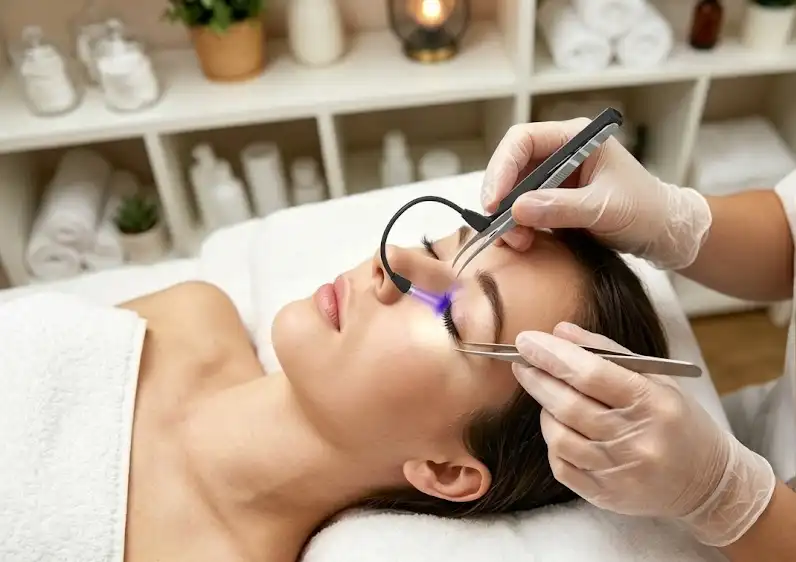
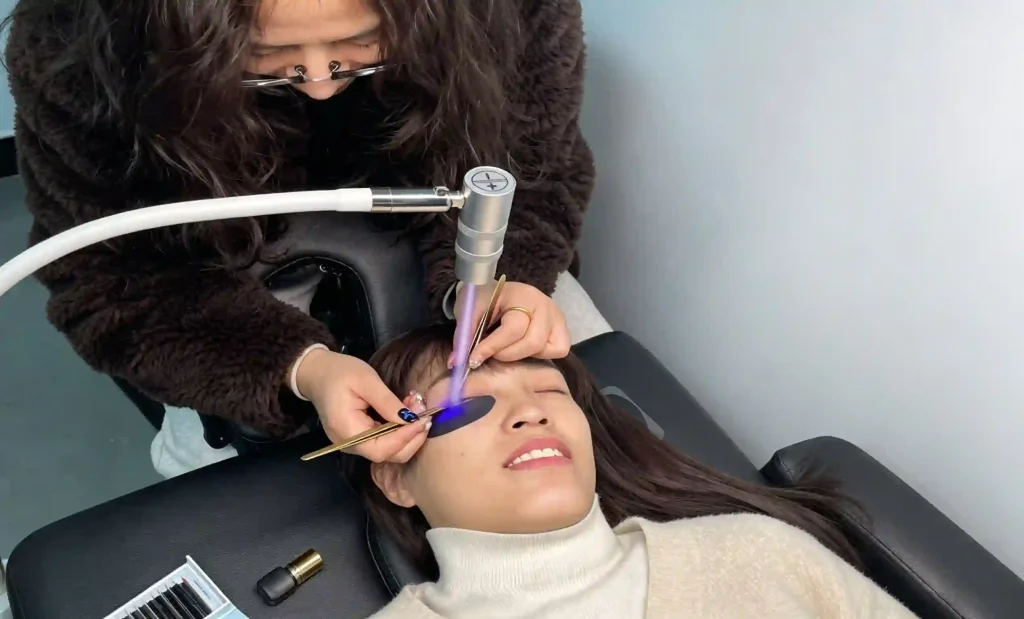
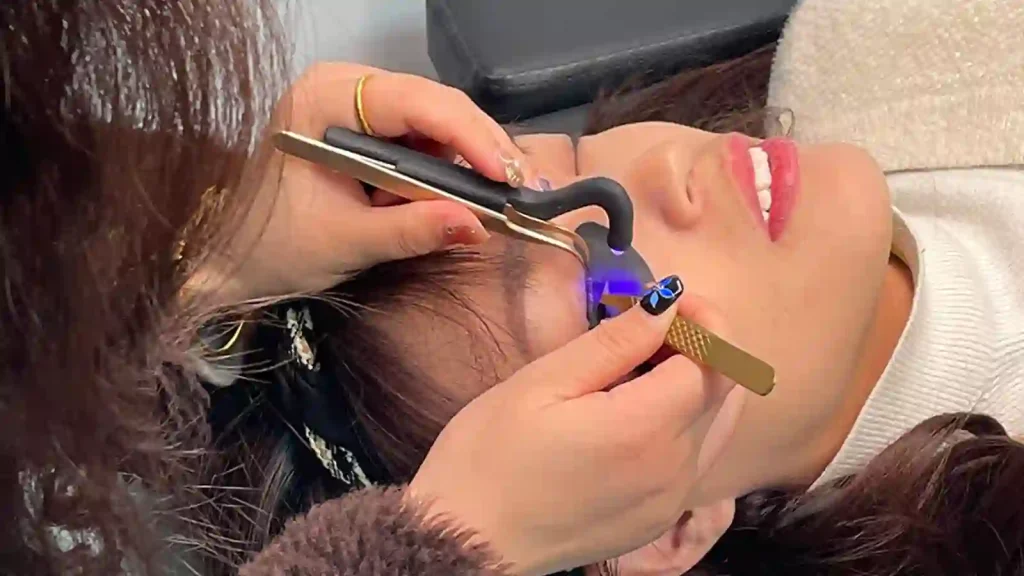
moderne Tweezer Lamp technology utilizes high-frequency light pulses to achieve this density without overwhelming the adhesive surface. By pulsing the energy, the lamp manages the thermal load while ensuring that the photo-initiator reaction is stimulated at its peak frequency.
Technical Performance Matrix: Curing Density
| Métrique | Standard Broad-Spectrum Curing | Precision Pulse Curing (Synergy System) |
| Polymerization Reaction Time | 3.0+ seconds | 0,5 seconde |
| Fan Closure Probability | High (Adhesive migration) | Minimal (Immediate geometric lock) |
| Intégrité des liaisons | Variable (Prone to moisture damage) | High-density cross-linking (Hydrophobic) |
| Tip Flexibility | Low (Brittle/Clumped) | High (Flexible/Natural) |
3. Protecting the Fan: The Role of High-Frequency Interaction
If your light source is not optimized for Curing Density, you are forcing your adhesive to perform a task that defies its chemical design.
3.1. Mitigating Adhesive Migration
Every millisecond that passes between placement and full polymerization is a liability. As you deepen your knowledge of science moderne des adhésifs, you realize that adhesive migration is the enemy of artistry. High-frequency light pulses act as a “time-stop” mechanism. Because the reaction is triggered so rapidly, the adhesive viscosity increases before it can flow up the lash fibers. This technical intervention is essential for high-retention lashing, ensuring the volume fan retains its intended shape for the duration of the set.
4. Engineering for Absolute Bond Integrity
Achieving total bond integrity is not solely about the light source; it requires an integrated engineering approach to the entire workspace ecosystem.
4.1. Engineering Standards for Reliability
We strictly adhere to Normes techniques de l'IEEE relatives à l'éclairage à semi-conducteurs to ensure that your light intensity remains perfectly stable across every single pulse. As emphasized by the CIE (International Commission on Illumination), precise spectral control is the foundation of industrial-grade chemical bonding. By translating this level of engineering precision to the salon environment, we empower lash artists to execute procedures with clinical consistency.
7. The Future of the Lash Industry
The transition to UV-initiated volume lashing is not merely an industry trend—it is a total technological shift. Brands that fail to adopt these precision systems will find themselves unable to compete with the quality, retention, and speed offered by those leveraging advanced curing density.
7.1. Training and Technical Literacy
Mastering these tools requires a new level of technical literacy. Artists must be trained not just in placement, but in the physics of the light source:
Distance Sensitivity: Understanding how irradiance density correlates to curing speed.
Beam Collimation: Ensuring the light is hitting the adhesive at the correct incident angle for maximum structural density.
System Maintenance: Recognizing that even a slight misalignment in optics can drastically alter the curing efficiency.
8. Conclusion: Perfecting the Art of the Fan
The perfect volume lash set is the intersection of manual artistry and high-precision engineering. By shifting your focus toward curing density and high-frequency light interactions, you can permanently solve the issue of fan closure and unlock new levels of retention. This evolution in your technical stack is exactly what elevates an artist to an industry-leading entrepreneur.
If you are ready to modernize your salon and standardize your results, explore our latest wireless lash solutions. Master the light, secure the integrity of the fan, and set a new standard for your brand.
5. Scaling Excellence: The Salon Operational Framework
For salon owners and brand builders, standardizing the curing protocol is the most effective way to eliminate operational variance. When your hardware is technically aligned with your chemical protocol, you remove the biggest variable in your customer service experience.
5.1. Standardizing Technical Protocols
Selon Professionnels de la gestion de la chaîne logistique (CSCMP), long-term brand equity is driven by procedural consistency. A salon that can guarantee uniform, perfect fans for every client, regardless of which artist is performing the service, will naturally command premium pricing. Furthermore, strictly adhering to OSHA lighting guidelines is not just a regulatory requirement; it is a commitment to the long-term visual health of your technicians—the most vital asset in your business.
6. Advanced Chemical Deep-Dive: The Polymer Lattice
To truly master Curing Density, we must examine the lattice structure formed within the lash base.
6.1. The Architecture of the Bond
When 395nm light strikes the adhesive, it catalyzes the formation of long, interconnected polymer chains. If the curing is erratic, these chains are disorganized, leading to a bond that breaks down under the natural oils and movement of the eyelid. Precision curing promotes “controlled density,” creating a lattice that is structurally rigid at the base (holding the fan) but remains flexible at the periphery (preventing breakage).
6.2. Thermal Regulation and Client Safety
One of the most frequent misconceptions in UV lashing is that higher intensity means higher heat. In reality, modern wireless lash solutions use sophisticated thermal management systems to ensure the energy remains focused on the photonic (chemical) reaction, rather than generating excessive heat. This protects the delicate eyelid skin while accelerating the curing timeline.