




1. The Difference Between a Supplier and a Partner
I was on a call with a brand owner last month. He had been sourcing UV lash lights for two years—three different suppliers, each one a “better deal” than the last. But he was exhausted.
“Every time I switch,” he told me, “I have to start over. New samples, new negotiations, new quality issues. I spend more time managing suppliers than I do growing my business.”
His problem wasn‘t that he couldn’t find suppliers. It was that he was selecting suppliers, not partners. He optimized for price and speed, not reliability and compatibility. And every time a better price appeared, he switched—never building the trust that unlocks better terms, priority production, and product innovation.
This guide is about manufacturer selection—not just finding a supplier, but choosing a long-term partner who can grow with your business.
If you are just beginning your UV lash light sourcing journey, see our sourcing mistakes guide for what to avoid before you start.
For a complete procurement strategy framework, see our sourcing strategy guide later in this series.
2. Step 1: Define What You Actually Need
Before you evaluate manufacturers, you need to define what you are looking for. Most buyers skip this step—and then wonder why they keep switching suppliers.
2.1 Product Requirements
Start with the technical specifications that matter for your market:
| Specification | Por qué es importante |
|---|---|
| Longitud de onda | Must match your adhesive‘s photoinitiator peak (typically 395–405nm) |
| Irradiance | Must deliver 50–200 mW/cm² at working distance (2–5 cm) |
| Beam focus | Focused beam, not floodlight—for precision curing |
| Safety certification | IEC 62471 required for EU, Japan, and most markets |
| Fuente de alimentación | Match your target market’s voltage and plug type |
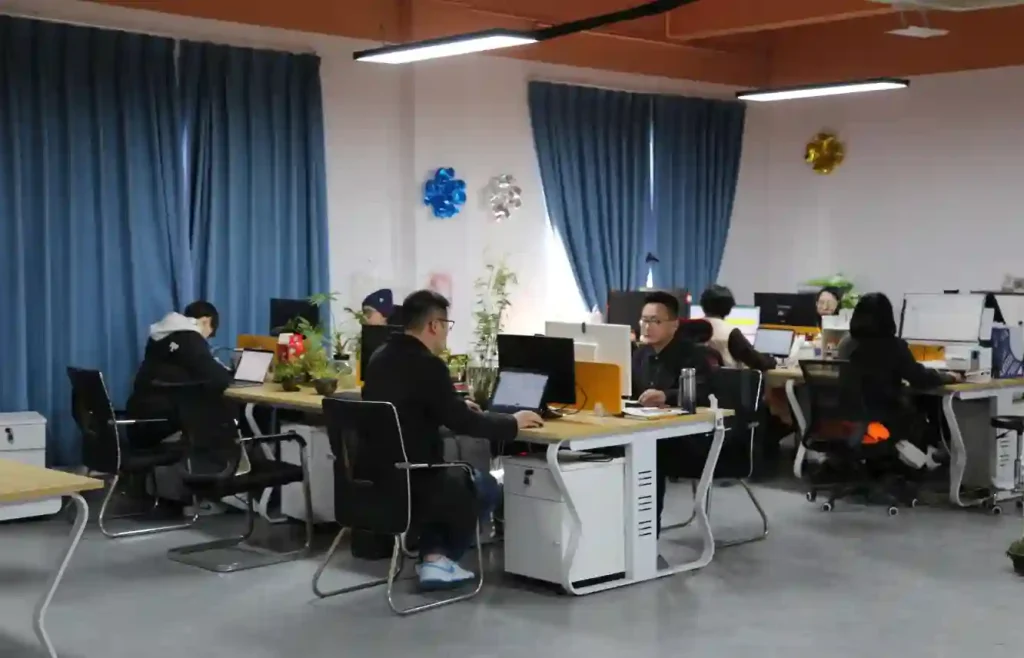
According to a B2B sourcing guide for UV lash lights, buyer decisions should start with three questions: what workflow will the lamp support, what specifications must the supplier prove, and what OEM details are needed before approval.
2.2 Business Requirements
Beyond the product itself, define your business requirements:
Order volume: Starting with 50 units? 500? 5,000?
Customization level: Stock product, logo-only private label, or full OEM?
Lead time: What is your acceptable window between order and delivery?
Payment terms: Standard 30/70, or something different?
Target market: Determines certification requirements and packaging language
2.3 The Non-Negotiable List
Write down the things you will not compromise on. Common non-negotiables for UV lash light buyers include:
IEC 62471 certification from an accredited lab
Wavelength stability over 1,000+ hours
On-time delivery rate above 95%
Replaceable components (for modular systems)
When you know your non-negotiables, you can quickly disqualify manufacturers who cannot meet them. This saves time and prevents bad partnerships.
3. Step 2: Identify Real Manufacturers (Not Traders)
The UV lash light market is full of trading companies posing as factories. According to a 2025 SourcifyChina audit, 78% of “verified” suppliers on major B2B platforms are actually trading companies, not factories.
Here is how to identify real manufacturers.
3.1 The Business License Check
Ask for the supplier‘s business license. Check two things:
Scope of operation: Does it include manufacturing (生产/制造) or only import/export (进出口)?
Registered address: Is it an industrial address or a commercial office?
A real factory has manufacturing in its scope and operates from an industrial location.
3.2 The Factory Video Request
Ask for a live video tour of the production floor. Not promotional footage—a real-time walkthrough showing:
Assembly lines
QC stations
Testing equipment
Workers assembling the product
A real factory can provide this within hours. A trading company will stall.
3.3 The QC Lead Test
Ask to speak with the quality control lead. A real factory will connect you—even if the QC lead doesn’t speak fluent English. A trading company will deflect and say the sales team can answer all questions.
3.4 The Traceability Question
Ask: “If I have a defect, can you trace it back to the specific batch of LEDs and the production date?”
A real factory has a traceability system. A trading company does not—because they don‘t control production.
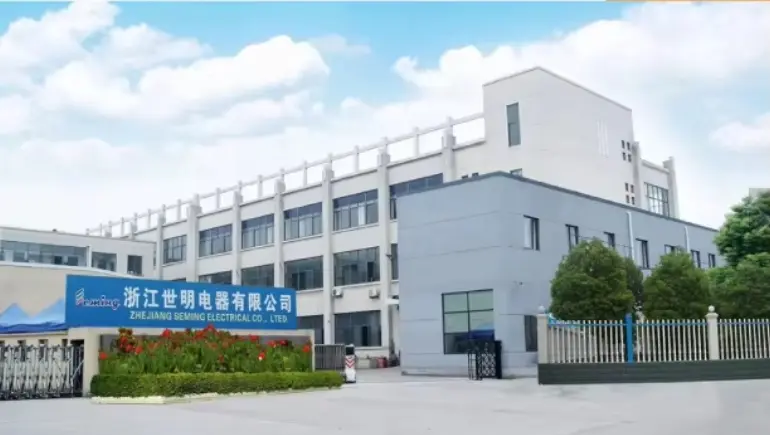
We are a direct manufacturer with full production visibility.
4. Step 3: Evaluate Quality Systems
Once you’ve identified real factories, evaluate their quality systems. This is where most buyers focus only on samples—and miss the bigger picture.
4.1 Incoming Inspection
Does the factory inspect components before they enter production? A proper incoming inspection checks:
LED wavelength and output
PCB functionality
Housing dimensions and finish
Power supply voltage and stability
Without incoming inspection, defects enter the production line and end up in finished products.
4.2 In-Process Inspection
Is there QC during assembly, or only at the end? In-process checks catch issues before they become finished product defects.
Busca:
Station-level checks (e.g., soldering quality, LED alignment)
Documented checkpoints
Trained QC staff on the production floor
4.3 Final Inspection and Testing
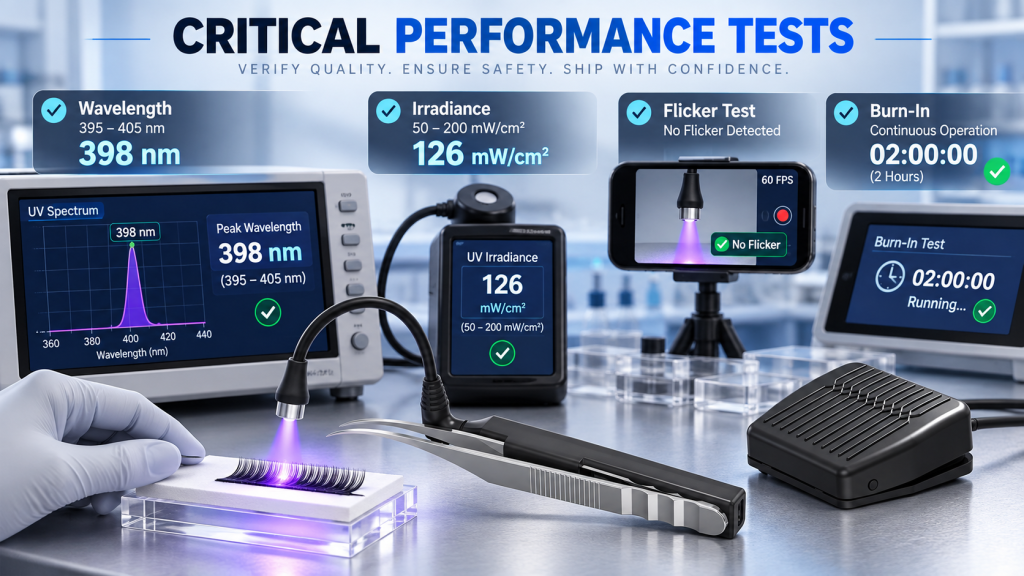
Every unit should be tested before packaging. For UV lash lights, critical tests include:
Wavelength verification (spectrometer)
Irradiance measurement (UV meter)
Functional test (on/off, timer, foot pedal)
Visual inspection (scratches, alignment, branding)
Ask to see the batch QC report. If it doesn’t exist, the QC process isn’t real.
4.4 Traceability and Rework
A mature factory has:
Batch traceability (which components went into which order)
Documented rework procedures
Defect rate tracking by type
These systems are what enable consistent quality at scale. Without them, quality varies from batch to batch.
5. Step 4: Verify Certifications Directly
Las certificaciones son el ámbito en el que más falsificaciones he visto. A continuación te explico cómo verificarlas.
5.1 Required Certifications for UV Lash Lights
| Certificación | Market | Qué cubre |
|---|---|---|
| IEC 62471 | Global | Photobiological safety |
| CE | Europe | Electrical safety, EMC, RoHS |
| RoHS | Global | Hazardous substances restriction |
| FCC | USA | Electromagnetic interference |
5.2 Verification Steps
Ask for the full test report—not just the certificate
Check the laboratory—is it accredited? (SGS, TUV, Intertek, UL)
Verify the report number—call the lab or check their online database
Confirm the model—the certification must match the exact product you are ordering
Check the date—certifications expire; request the current version
According to AURA Monaco‘s UV safety certification guide, the IEC 62471 test is a standardized test used worldwide to measure the photobiological effects of luminaires on the skin and eye. Devices that pass this test prove they can be used without hesitation in close-proximity beauty applications.
All our UV lash lights carry IEC 62471 and CE certifications.
6. Step 5: Assess Long-Term Compatibility
The final step is the most important—and the most overlooked. A manufacturer can have great quality, fair prices, and valid certifications. But if they cannot grow with you, the partnership has a ceiling.
6.1 Production Capacity
Can the factory scale with your growth? Ask:
What is your monthly production capacity for UV lash lights?
What is your capacity during peak season?
Do you have multiple production lines?
What happens if my order volume triples?
A factory that can only handle 500 units per month is not the right partner if your goal is 5,000.
6.2 Customization Capability
Can the factory modify the product for your brand? Ask:
Can you change the LED chip supplier?
Can you adjust the beam angle?
Can you customize the packaging?
Can you develop a new product from a concept?
A factory with in-house engineering can do this. A trading company cannot.
6.3 Communication and Responsiveness
How does the factory handle communication? Test this during the vetting process:
How quickly do they respond to emails?
Do they answer technical questions directly, or defer to “the factory”?
Do they proactively update you on production status?
According to supplier performance data, suppliers with response times exceeding four hours often exhibit higher defect rates and longer resolution periods. Fast, clear communication is a leading indicator of reliability.
6.4 Cultural Fit
This is intangible but important. A good partner listens. They push back when you ask for something unreasonable. And when there’s a better way, they suggest alternatives. A partner who says “yes” to everything is not helping you—they are setting you up for failure.
For more on building long-term supplier relationships, see our supplier relationship management guide later in this series.
7. The Selection Scorecard
Use this scorecard to evaluate manufacturers objectively.
| Categoría | Peso | Score (1-5) |
|---|---|---|
| Product specifications meet requirements | 20% | |
| Factory verification (real manufacturer) | 15% | |
| Quality systems (incoming, in-process, final) | 20% | |
| Validez de la certificación | 15% | |
| Production capacity and scalability | 10% | |
| Customization capability | 10% | |
| Communication and responsiveness | 10% | |
| Total | 100% |
8. Veredicto final
| Paso | Key Action |
|---|---|
| 1. Define needs | Write down specifications and non-negotiables |
| 2. Identify real manufacturers | Verify business license, request video tour, test QC access |
| 3. Evaluate quality systems | Check incoming, in-process, and final inspection |
| 4. Verify certifications | Call the lab, confirm the report number |
| 5. Assess long-term fit | Check capacity, customization, communication |
Selecting a UV lash light manufacturer is not a one-time transaction. It is the beginning of a relationship that will shape your product quality, your customer satisfaction, and your brand reputation for years.
The cheapest supplier is rarely the best partner. The fastest shipper is not always the most reliable. And the factory that says “yes” to everything is often the one that delivers the least.
Use the framework in this guide. Take your time. Ask the hard questions. And when you find a manufacturer who meets your standards, invest in that relationship—because a good manufacturing partner is one of the most valuable assets your brand can have.
Related UV Lash Reading
Una nota de Seminglight – We are a direct UV lash light manufacturer with in-house R&D, full QC systems, and verified certifications. Luces UV para pestañas de una fábrica que puedas comprobar. Descubre nuestra colección de pestañas UV o Contacto for factory visits and partnership discussions.
Jim Jiang

Fundador de Seming, diseñador jefe de productos con 20 años de experiencia. Especializado en personalización, innovación y soluciones de iluminación para iluminación fotográfica, iluminación de belleza y herramientas de belleza, y mucho más.