




1. The Question That Stops Most Brand Owners
The decision has been made: you are launching your own UV lash light brand. A manufacturer is lined up. An order is ready to go.
Then the sales rep asks: “Do you want OEM or private label?”
You pause. The difference between the two is unclear. Which one you need? That is another question. And the cost—or the value it delivers for your brand—remains uncertain. And you are not sure which one will cost more—or deliver more value for your brand.
This is a common moment of confusion. OEM and private label are often used interchangeably, but they mean different things. Choosing the wrong one can cost you money, time, and market positioning.
This guide explains the difference between OEM and private label for UV lash lights—and helps you decide which path fits your brand.
If you are still evaluating manufacturers, see our manufacturer selection guide for a five-step framework.
2. The Core Difference: Who Designs the Product?
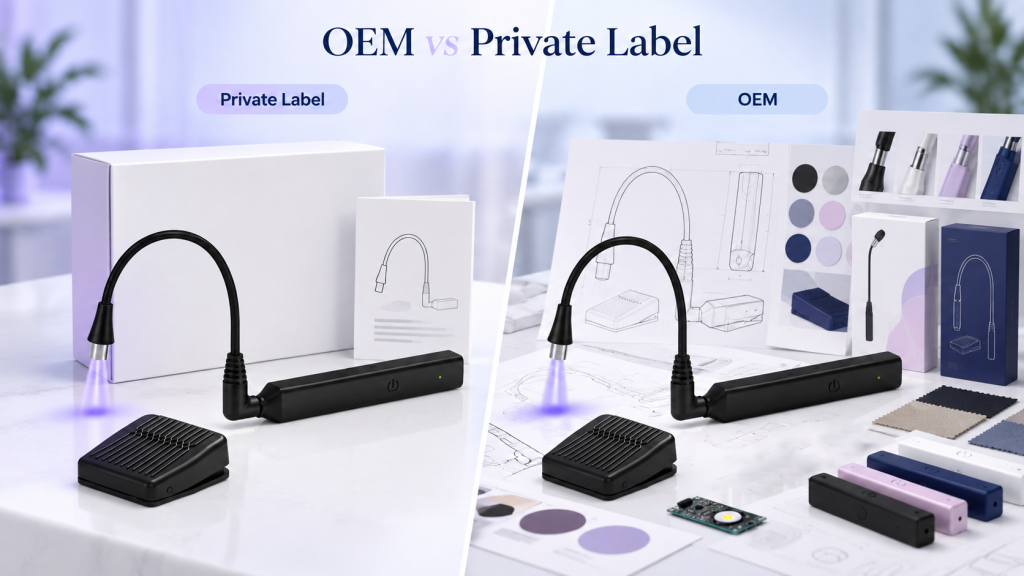
The simplest way to understand the difference is to ask one question: Who designs the product?
2.1 Private Label: You Brand an Existing Product
With private label, the manufacturer already has a product designed and in production. You put your logo on it, maybe customize the packaging, and sell it as your own.
The product itself is not unique. Other brands may sell the same lamp with their own logos. What makes it “yours” is the branding, the packaging, and the marketing.
You control: Branding, packaging, pricing, marketing
You do not control: Product design, specifications, internal components
2.2 OEM: You Design the Product (or Customize It Significantly)
OEM stands for Original Equipment Manufacturer. In the UV lash light context, OEM means the manufacturer builds a product to your specifications—or customizes an existing design to meet your requirements.
This can range from minor modifications (custom color, different LED chip) to full custom development (new housing, custom PCB, proprietary features).
You control: Product design, specifications, internal components, branding, packaging
You do not control: Manufacturing process (but you can specify requirements)
2.3 The Quick Comparison
| Faktor | Private Label | OEM |
|---|---|---|
| Product design | Manufacturer‘s existing design | Customized or fully custom |
| Differentiation | Branding only | Product + branding |
| MOQ | Lower (50–100 units) | Higher (500–1,000+ units) |
| Setup cost | Low (logo/packaging only) | High (tooling, engineering) |
| Lieferzeit | Shorter | Longer |
| Unit cost | Nach unten | Higher (initially) |
| Barrier to entry | Niedrig | Hoch |
| Competitive moat | Weak | Strong |
3. When Private Label Makes Sense
Private label is the right choice for many first-time brand owners—but not all.
3.1 You Are Testing the Market
If you are not sure whether your audience will buy UV lash lights from you, private label is a low-risk way to find out. You invest less, order less, and learn faster.
3.2 You Have Limited Budget
Private label requires less upfront investment. You do not pay for tooling, engineering, or custom development. You pay for the product plus branding—nothing more.
3.3 You Are Building a Brand, Not a Product
If your competitive advantage is your brand, your community, or your training programs—not the lamp itself—private label is sufficient. The product is a vehicle for your brand, not the differentiator.
3.4 You Need Inventory Fast
Private label has shorter lead times. If you need stock quickly—for a launch, a trade show, or a seasonal promotion—private label is the faster path.
3.5 The Private Label Reality Check
Private label has limitations. You cannot claim your product is unique. You cannot prevent competitors from selling the same lamp. And you cannot customize the specifications to address a specific customer pain point.
If those limitations matter, OEM may be the better path.
4. When OEM Makes Sense
OEM is a bigger investment—but it delivers bigger returns when done right.
4.1 You Have a Specific Product Vision
If you know exactly what you want—a specific wavelength, a unique form factor, a proprietary feature—OEM is the only way to get it. Private label cannot deliver a product that does not already exist.
4.2 You Want a Competitive Moat
A custom product is harder to copy. Competitors can copy your branding, but they cannot copy your proprietary design. This creates a barrier to entry that private label cannot match.
4.3 You Are Scaling Beyond Test Orders
If your first private label order sold out and you are ready to scale, OEM can reduce your long-term unit cost. The upfront tooling investment is amortized over thousands of units, bringing your per-unit cost below what private label can offer.
4.4 You Have a Manufacturing Partner You Trust
OEM requires a deeper relationship with your manufacturer. You need to trust their engineering capability, their quality systems, and their communication. If you have found a partner who meets those standards, OEM is the natural next step.
4.5 The OEM Reality Check
OEM requires patience. Development takes time. Tooling costs money. And not every OEM project succeeds—some designs fail testing, some features do not work as expected, and some timelines slip.
Before committing to OEM, make sure you have the budget, the timeline, and the risk tolerance to see it through.

5. The Cost Comparison: What You Actually Pay
The upfront costs of private label and OEM are very different. Here is a realistic comparison.
5.1 Private Label Costs (100-Unit Order)
| Cost Item | Betrag |
|---|---|
| Product (100 units × $18) | $1,800 |
| Logo-Druck | $100–$300 |
| Custom packaging setup | $200–$500 |
| Versand | $300–$600 |
| Total first order | $2,400–$3,200 |
5.2 OEM Costs (1,000-Unit Order)
| Cost Item | Betrag |
|---|---|
| Tooling/mold | $2,000–$8,000 |
| Engineering and design | $1,000–$3,000 |
| Product (1,000 units × $14) | $14,000 |
| Custom packaging | $500–$1,500 |
| Versand | $800–$1,500 |
| Total first order | $18,300–$28,000 |
5.3 The Break-Even Calculation
OEM costs more upfront—but the unit cost is lower. How many units do you need to sell before OEM becomes cheaper than private label?
Assume:
Private label unit cost: $18
OEM unit cost: $14
OEM setup cost: $5,000
Break-even = $5,000 ÷ ($18 – $14) = 1,250 units
If you sell more than 1,250 units, OEM is cheaper. If you sell fewer, private label is cheaper.
This is a simplified calculation. It does not account for the value of differentiation, the ability to charge a premium, or the cost of managing two different supply chains. But it illustrates the basic trade-off.
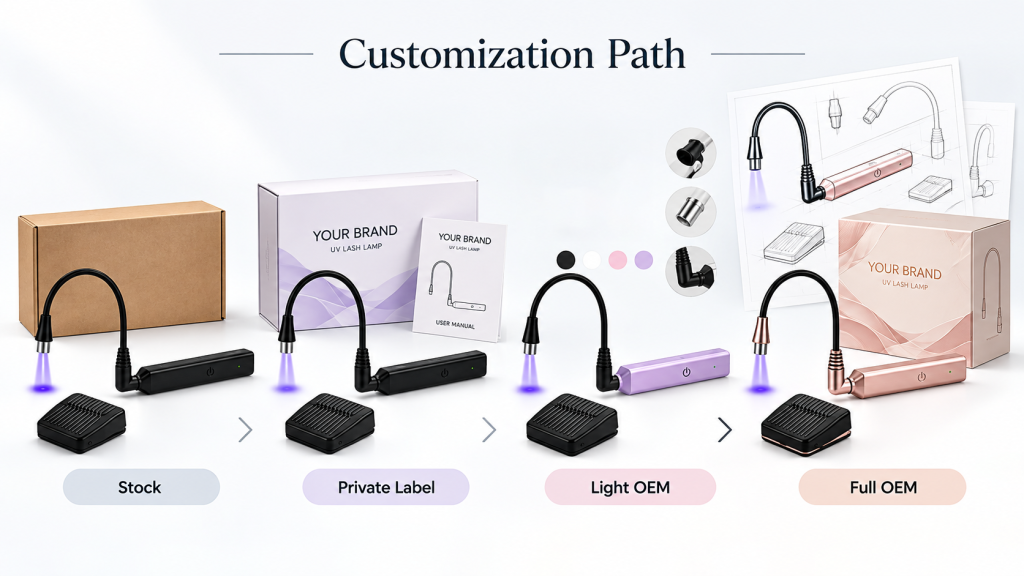
6. The Customization Spectrum
OEM and private label are not binary choices. There is a spectrum of customization options between them.
| Level | What You Get | Typische Mindestbestellmenge | Typical Setup Cost |
|---|---|---|---|
| 1. Stock + sticker | Manufacturer‘s product with your sticker on the box | 50 units | $0–$100 |
| 2. Private label | Manufacturer‘s product with your logo and custom box | 100–300 units | $300–$800 |
| 3. Light OEM | Existing product with custom color, LED chip, or packaging | 300-500 Einheiten | $1,000–$3,000 |
| 4. Full OEM | Custom design, new tooling, proprietary features | Über 1.000 Einheiten | $5,000–$15,000+ |
We support all levels of customization from logo printing to full OEM development.
7. Decision Framework: Which Path Is Right for You?
Use this framework to decide.
| If You… | Choose… |
|---|---|
| Are testing the market | Private label |
| Have a limited budget | Private label |
| Need inventory fast | Private label |
| Have a specific product vision | OEM |
| Want a competitive moat | OEM |
| Are scaling beyond 1,000 units | OEM |
| Have a trusted manufacturing partner | OEM |
| Are not sure about demand | Private label first, then OEM |
The safest path for most new brands is: start with private label, prove demand, then transition to OEM.
8. Endgültiges Urteil
| Faktor | Private Label | OEM |
|---|---|---|
| Product uniqueness | Niedrig | Hoch |
| Upfront cost | Niedrig | Hoch |
| Unit cost | Höher | Nach unten |
| MOQ | Nach unten | Höher |
| Lieferzeit | Shorter | Longer |
| Barrier to entry | Niedrig | Hoch |
| Competitive moat | Weak | Strong |
| Am besten für | Testing, branding, speed | Differentiation, scale, long-term |
The choice between OEM and private label is not about which is “better.” It is about which is right for your stage, your budget, and your vision.
Private label lets you start fast and learn quickly. OEM lets you build something unique and defensible. Most successful brands use both—private label to test and OEM to scale.
The key is to start where you are. If you are just beginning, private label is the right first step. If you have proven demand and a clear product vision, OEM is the natural next step.
Either way, the most important decision is not OEM vs private label. It is choosing the right manufacturing partner—one who can support you at every stage of your growth.
Related UV Lash Reading
Eine Notiz von Seminglight – We support both private label and OEM development for UV lash lights, from 50-unit trial orders to full custom manufacturing. UV-Wimpernleuchten with flexible customization options. Entdecken Sie unsere UV-Wimpernkollektion oder kontaktieren Sie uns to discuss your brand’s needs.
Jim Jiang

Gründer von Seming, leitender Produktdesigner mit 20 Jahren Erfahrung. Spezialisiert auf Anpassung, Innovation und Beleuchtungslösungen für Fotografie, Beauty-Beleuchtung und Beauty-Tools und mehr.